
We had twelve of us last night for a stimulating and charming evening of Othello, whose soaring language overcomes the powerful repulsiveness of Iago.
Cassio's marital status came up in the post-reading discussions. It makes for a tidier plot if he is not married. The only marital reference is early in I, i, when Iago refers to Cassio as being "A fellow almost damn’d in a fair wife." The Arden edition gives a variety of semi-plausible readings of the line (He is almost damned because he is almost married, etc.). And of course Iago lies and Shakespeare is forgetful. This is the only reference to a wife for Cassio, probably best ignored.
The Oxford edition notes that (besides the four deaths in Act V) Iago provokes THREE violent public confrontrations during the play – the standoff in the first scene, when Brabantio and his men confront and seek to arrest Othello; getting Cassio drunk in Cyprus and having Rodrigo start a fight with him in Act II; and in the last act, when he gets Rodrigo to attack Cassio, ending with Iago killing Rodrigo and wounding Cassio.
Next up, we're off to Vienna for the Shakespeare's other play based on story by Cinthio, Measure For Measure, a rather unpleasant play that was originally listed as a comedy (now classified as a Problem Play) with perhaps the most bizarre ending in the canon. Looking at mid-March, after Rita and I return from Spain.
Have a great holiday season!
Steve
Clyde McPhatter and The Drifters great version of White Christmas:
https://www.youtube.com/watch?v=jWQnhPGHYVc
Shakespeare
Moderator: michael
-
Steve Minkin

- Posts: 1677
- Joined: Thu Nov 03, 2016 8:11 pm
- Location: Healdsburg, California
- Contact:
-
Steve Minkin
- Posts: 1677
- Joined: Thu Nov 03, 2016 8:11 pm
- Location: Healdsburg, California
- Contact:
Re: Shakespeare
HAPPY NEW YEAR!
The 2020s? (Good grief!) Good luck!
ESCALUS: Some rise by sin, and some by virtue fall. (II, i)
ANGELO: [Aside] She speaks, and 'tis
Such sense, that my sense breeds with it. (II, ii)
ANGELO: Say what you can, my false o’erweighs your true. (II, iv)
I've always thought that the Folio's original 'Comedy' classification of this frequently unpleasant play was a default category because the play ends with multiple marriages (although a couple of grooms are slated to be executed immediately following the nuptials) and none of the characters actually die during the play (although there are many death sentences meted out). But the Globe Theater's 2015 production (available on DVD) is genuinely funny, and has convinced me that with the right director and cast the play can be what we would call today a dark comedy, a quite funny dark comedy. Brendan O’Hea as Lucio lights up the stage, and Kurt Egyiawan is a splendidly wound-too-tight Angelo. (The BBC version, also available on DVD, has much to recommend it -- it is not limited to a stage and features some solid performances; but the Globe version is far more engaging and showcases the two superb performances I mentioned.) Here's a brief segment of the Globe's take on Elbow's entrance:
https://www.youtube.com/watch?v=K5LTGk5IHh8
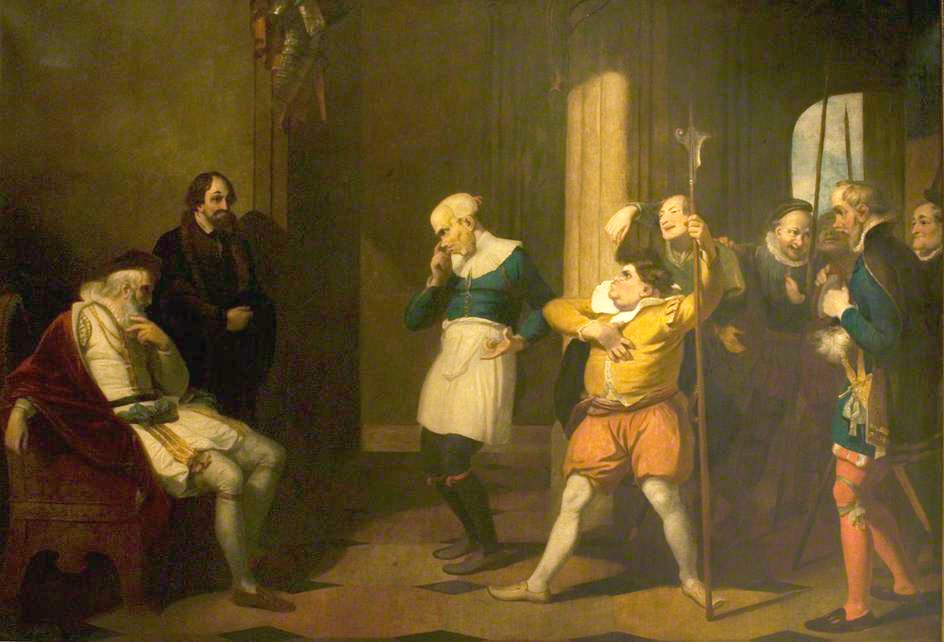
And here's a painting of the same scene by architect Robert Smirke:
https://static.unotate.com/illustration ... 3/full.png
Measure for Measure's primary source was the same as Othello's – a collection of stories by Cinthio (aka Giambattista Giraldi), "Hecatommithi," 1565. Cinthio then wrote a play based on the story. Another key source for Shakespeare was a play based on the Cinthio story from 1578 by George Whetstone, "Promos and Cassandra." I'm finding a difference of opinion as to which of the three authors introduced the key comic elements of the Bed Trick and the Head Trick. The Bed Trick involves fooling Angelo into making love – silently and in the dark – to a woman other than the one he thinks he is enjoying; the Head Trick involves providing a severed head of a prisoner who died of natural causes in lieu of the severed head of one of the play's characters in order to fool the authorities.
Here's the key Angelo/ Isabella scene (II, iv) played with a maximum of physicality, David Tennant as Angelo, insightful commentary by the director:
https://www.youtube.com/watch?v=q_8UMAmLYtU
"The surest sign of wisdom is constant cheerfulness." Montaigne, quoted in A Gentleman In Moscow.
Let's tentatively look at Wednesday, March 18, for our (second) reading of MFM. That ought to give Rita and me enough time to return to California time following our adventures in southern Spain. If you find you have a problem with date, please let me know.
Thanks,
Steve
Pepper Adams – I've Just Seen Her:
https://www.youtube.com/watch?v=QIM-qWo_xZg
The 2020s? (Good grief!) Good luck!
ESCALUS: Some rise by sin, and some by virtue fall. (II, i)
ANGELO: [Aside] She speaks, and 'tis
Such sense, that my sense breeds with it. (II, ii)
ANGELO: Say what you can, my false o’erweighs your true. (II, iv)
I've always thought that the Folio's original 'Comedy' classification of this frequently unpleasant play was a default category because the play ends with multiple marriages (although a couple of grooms are slated to be executed immediately following the nuptials) and none of the characters actually die during the play (although there are many death sentences meted out). But the Globe Theater's 2015 production (available on DVD) is genuinely funny, and has convinced me that with the right director and cast the play can be what we would call today a dark comedy, a quite funny dark comedy. Brendan O’Hea as Lucio lights up the stage, and Kurt Egyiawan is a splendidly wound-too-tight Angelo. (The BBC version, also available on DVD, has much to recommend it -- it is not limited to a stage and features some solid performances; but the Globe version is far more engaging and showcases the two superb performances I mentioned.) Here's a brief segment of the Globe's take on Elbow's entrance:
https://www.youtube.com/watch?v=K5LTGk5IHh8
And here's a painting of the same scene by architect Robert Smirke:
https://static.unotate.com/illustration ... 3/full.png
Measure for Measure's primary source was the same as Othello's – a collection of stories by Cinthio (aka Giambattista Giraldi), "Hecatommithi," 1565. Cinthio then wrote a play based on the story. Another key source for Shakespeare was a play based on the Cinthio story from 1578 by George Whetstone, "Promos and Cassandra." I'm finding a difference of opinion as to which of the three authors introduced the key comic elements of the Bed Trick and the Head Trick. The Bed Trick involves fooling Angelo into making love – silently and in the dark – to a woman other than the one he thinks he is enjoying; the Head Trick involves providing a severed head of a prisoner who died of natural causes in lieu of the severed head of one of the play's characters in order to fool the authorities.
Here's the key Angelo/ Isabella scene (II, iv) played with a maximum of physicality, David Tennant as Angelo, insightful commentary by the director:
https://www.youtube.com/watch?v=q_8UMAmLYtU
"The surest sign of wisdom is constant cheerfulness." Montaigne, quoted in A Gentleman In Moscow.
Let's tentatively look at Wednesday, March 18, for our (second) reading of MFM. That ought to give Rita and me enough time to return to California time following our adventures in southern Spain. If you find you have a problem with date, please let me know.
Thanks,
Steve
Pepper Adams – I've Just Seen Her:
https://www.youtube.com/watch?v=QIM-qWo_xZg
-
Steve Minkin
- Posts: 1677
- Joined: Thu Nov 03, 2016 8:11 pm
- Location: Healdsburg, California
- Contact:
MFM second notes
Cinthio' story, on which Measure For Measure is based, was itself partly based on a story that was evidently circulating about 20 years earlier, and is preserved in a Hungarian letter from 1547 (included in the Arden edition). The letter's story goes that in a town near Milan two men got into a heated fight, one killed the other and was arrested and jailed. The killer was adored by his beautiful wife; she went to the judge to plead for his life, and the judge offered to spare her husband's life in exchange for sex with her. Her husband's brothers encouraged her to do it. She did, but the judge had her husband executed anyway. After failing to get justice locally, she brought her grievance to the supreme governor of Milan, and he ordered the local judge to marry the woman, following which he was executed – the same penalty The Duke in MFM imposes on Angelo.
Actresses playing Isabella are asked how they will handle the line: "More than our brother is our chastity." She is at this point weighing whether to yield her virginity to Angelo to save her brother's life. In today's cultural environment, Isabella's line can seem prudish and cold-hearted. But Auden points out that she is keeping a sacred vow she made, and argues (and this is in the immediate aftermath of WWII) "Suppose Angelo were an enemy agent who told Isabella she had to give up the plans of a secret airplane base or they would have to kill her brother. People then would understand and say that she is quite right in her vow."
Of course both Angelo and Isabella are hypermoralists and intellectuals who appear to be coming into their own late sexual awakenings as this supercharged situation unfolds. Talk about bad timing! (In Cinthio's story, Isabella is 18 and her brother is 16.)
The play contains this single song, 'Take O Take These Lips Away,' which opens Act IV. Shakespeare's lyrics can likely be traced to the Latin poem, Ad Lydiam. John Wilson's musical setting of the poem dates from about 1625:
https://www.youtube.com/watch?v=734m1Ln1fcE
"Intellectually fashionable since the end of [WWII], Measure For Measure has undergone a total reversal of meaning from a parable on divine justice to a fable of social oppression." (Irving Wardle)
RSC edition tells us that "The Restoration period allowed for the introduction of scenery and women onto the stage." Restoration productions of MFM downplayed the sex and low-life scenes. William Davenport's adaptation, "The Law Against Lovers" (1662), incorporates Beatrice and Benedick into the play (Benedick as Angelo's younger brother), Isabella and Angelo wind up with each other, and the Duke becomes a monk.
Coleridge writes "Measure For Measure is the single exception to the delightfulness of Shakespeare's plays. It is a hateful work, although Shakespeare throughout."
The play became increasingly bowdlerized during the Victorian era, one contemporary critic writing that there was "no other play of Shakespeare's in which so much of the dialogue is absolutely unspeakable before a modern audience."
The first celebrated modern version was the 1950 Stratford production directed by Peter Brooks, who used one of his accented pauses at a key point in the last act: Mariana is begging Isabella to kneel with her before the Duke to plead for the life of Angelo, and Brooks has Isabella wait before kneeling for as long as she thinks the audience can stand it, which started off at 35 seconds but went on as long as two minutes in some productions, "a silence in which the abstract notion of mercy became concrete for that moment to those present." (JC Trewin)
The 1998 production at Ashland, Oregon, used seven actors, each actor played both a high and low character, the actress playing Isabella also playing Mistress Overdone.
ESCALUS
Your mistress’ name?
POMPHEY
Mistress Overdone.
ESCALUS
Hath she had any more than one husband?
POMPEY
Nine, sir; Overdone by the last.
Still looking at March 18 for our reading.
Bright moments,
Steve
"I'm not Mr. Right, I'm Mr. Right Now!" :
https://www.youtube.com/watch?v=T4bvrywf0xg
Actresses playing Isabella are asked how they will handle the line: "More than our brother is our chastity." She is at this point weighing whether to yield her virginity to Angelo to save her brother's life. In today's cultural environment, Isabella's line can seem prudish and cold-hearted. But Auden points out that she is keeping a sacred vow she made, and argues (and this is in the immediate aftermath of WWII) "Suppose Angelo were an enemy agent who told Isabella she had to give up the plans of a secret airplane base or they would have to kill her brother. People then would understand and say that she is quite right in her vow."
Of course both Angelo and Isabella are hypermoralists and intellectuals who appear to be coming into their own late sexual awakenings as this supercharged situation unfolds. Talk about bad timing! (In Cinthio's story, Isabella is 18 and her brother is 16.)
The play contains this single song, 'Take O Take These Lips Away,' which opens Act IV. Shakespeare's lyrics can likely be traced to the Latin poem, Ad Lydiam. John Wilson's musical setting of the poem dates from about 1625:
https://www.youtube.com/watch?v=734m1Ln1fcE
"Intellectually fashionable since the end of [WWII], Measure For Measure has undergone a total reversal of meaning from a parable on divine justice to a fable of social oppression." (Irving Wardle)
RSC edition tells us that "The Restoration period allowed for the introduction of scenery and women onto the stage." Restoration productions of MFM downplayed the sex and low-life scenes. William Davenport's adaptation, "The Law Against Lovers" (1662), incorporates Beatrice and Benedick into the play (Benedick as Angelo's younger brother), Isabella and Angelo wind up with each other, and the Duke becomes a monk.
Coleridge writes "Measure For Measure is the single exception to the delightfulness of Shakespeare's plays. It is a hateful work, although Shakespeare throughout."
The play became increasingly bowdlerized during the Victorian era, one contemporary critic writing that there was "no other play of Shakespeare's in which so much of the dialogue is absolutely unspeakable before a modern audience."
The first celebrated modern version was the 1950 Stratford production directed by Peter Brooks, who used one of his accented pauses at a key point in the last act: Mariana is begging Isabella to kneel with her before the Duke to plead for the life of Angelo, and Brooks has Isabella wait before kneeling for as long as she thinks the audience can stand it, which started off at 35 seconds but went on as long as two minutes in some productions, "a silence in which the abstract notion of mercy became concrete for that moment to those present." (JC Trewin)
The 1998 production at Ashland, Oregon, used seven actors, each actor played both a high and low character, the actress playing Isabella also playing Mistress Overdone.
ESCALUS
Your mistress’ name?
POMPHEY
Mistress Overdone.
ESCALUS
Hath she had any more than one husband?
POMPEY
Nine, sir; Overdone by the last.
Still looking at March 18 for our reading.
Bright moments,
Steve
"I'm not Mr. Right, I'm Mr. Right Now!" :
https://www.youtube.com/watch?v=T4bvrywf0xg
-
Steve Minkin
- Posts: 1677
- Joined: Thu Nov 03, 2016 8:11 pm
- Location: Healdsburg, California
- Contact:
M4M -- 3rd Notes
Our opera maven writes:
M4M also provided the raw material for Wagner’s second opera, “Das Liebesverbot.” It’s seldom done (by common consent) and I’ve only ever heard snippets.
But the story of its debut is a hoot. Says Wikipedia:
"Poorly attended and with a lead singer who forgot the words and had to improvise, it was a resounding flop and its second performance had to be canceled after a fist-fight between the prima donna's husband and the lead tenor broke out backstage before the curtain had even risen; only three people were in the audience. It was never performed again in Wagner's lifetime.”
Hoping to make this one.
Joe
^^^^
" . . . Thou hast nor youth, nor age,
But as it were an after-dinner's sleep,
Dreaming on both . . ."
Duke, III, i
I mentioned that Coleridge called M4M a 'hateful play.' He thought the comic elements were 'disgusting' and the serious aspects 'horrible.' Hazlitt, however, appreciated the play's rejection of conventional morality, writing that "Shakespeare was in one sense the least moral of all writers; for morality (commonly so called) is made up of antipathies; and his talent consisted of sympathy with human nature, in all its shapes, degrees, depressions and elevations. The object of the pedantic moralist is to find out the bad in everything: his was to show that 'there is some soul of good in things evil.'" (HV)
Differing from Auden's position of taking Isabella's vow of chastity solemnly, Arden editor JW Lever seems quite certain that the Protestant audiences of Shakespeare's day would have felt little sympathy for Isabella insisting on her virginity over her brother's life. As Angelo points out, the morality of the day held that sins committed under force were not sins. Lever writes, "Accordingly 'shame' not sin, 'honour' not charity, are seen now as the all-important considerations, and Claudio's duty to Isabella as superseding her duty to him." This view sees her as being driven by the secular code that prized a maiden's chastity as the standard of honor for her family, and not driven by religious doctrine.
In their first interaction, Isabella asks Angelo to look into his own heart to see if he has ever felt the urge to sin as Claudio has. The Arden edition notes that Angelo's desire is increased because she has made him conscious of it.
Before his second meeting with Isabella, Angelo cries, "Blood, thou art blood," an ironic contrast to Lucio's earlier description of him as "a man whose blood is very snow-broth."
Director Gregory Doran likens the Vienna of Shakespeare's day to the Vienna at the beginning of the 20th Century, particularly citing painter Egon Schiele's works as an example of the kind of "forensic analysis of human sexuality" which seems to "accord closely with Shakespeare's obsessions in this play."
When Claudio tells Isabella of the potential horrors of the afterlife, he speaks of having to "reside/ In thrilling region of thick-ribbed ice." The image is from Virgil, who wrote of a frozen purgatory for sins of passion.
Keystone Cops: Elbow and Dogberry (Much Ado) share the same job, the same tendency to comically misspeak, and even some of the same lines and gags.
Still looking at March 18 for the reading.
Steve
https://www.youtube.com/watch?v=3Ro-gEyxmJQ
M4M also provided the raw material for Wagner’s second opera, “Das Liebesverbot.” It’s seldom done (by common consent) and I’ve only ever heard snippets.
But the story of its debut is a hoot. Says Wikipedia:
"Poorly attended and with a lead singer who forgot the words and had to improvise, it was a resounding flop and its second performance had to be canceled after a fist-fight between the prima donna's husband and the lead tenor broke out backstage before the curtain had even risen; only three people were in the audience. It was never performed again in Wagner's lifetime.”
Hoping to make this one.
Joe
^^^^
" . . . Thou hast nor youth, nor age,
But as it were an after-dinner's sleep,
Dreaming on both . . ."
Duke, III, i
I mentioned that Coleridge called M4M a 'hateful play.' He thought the comic elements were 'disgusting' and the serious aspects 'horrible.' Hazlitt, however, appreciated the play's rejection of conventional morality, writing that "Shakespeare was in one sense the least moral of all writers; for morality (commonly so called) is made up of antipathies; and his talent consisted of sympathy with human nature, in all its shapes, degrees, depressions and elevations. The object of the pedantic moralist is to find out the bad in everything: his was to show that 'there is some soul of good in things evil.'" (HV)
Differing from Auden's position of taking Isabella's vow of chastity solemnly, Arden editor JW Lever seems quite certain that the Protestant audiences of Shakespeare's day would have felt little sympathy for Isabella insisting on her virginity over her brother's life. As Angelo points out, the morality of the day held that sins committed under force were not sins. Lever writes, "Accordingly 'shame' not sin, 'honour' not charity, are seen now as the all-important considerations, and Claudio's duty to Isabella as superseding her duty to him." This view sees her as being driven by the secular code that prized a maiden's chastity as the standard of honor for her family, and not driven by religious doctrine.
In their first interaction, Isabella asks Angelo to look into his own heart to see if he has ever felt the urge to sin as Claudio has. The Arden edition notes that Angelo's desire is increased because she has made him conscious of it.
Before his second meeting with Isabella, Angelo cries, "Blood, thou art blood," an ironic contrast to Lucio's earlier description of him as "a man whose blood is very snow-broth."
Director Gregory Doran likens the Vienna of Shakespeare's day to the Vienna at the beginning of the 20th Century, particularly citing painter Egon Schiele's works as an example of the kind of "forensic analysis of human sexuality" which seems to "accord closely with Shakespeare's obsessions in this play."
When Claudio tells Isabella of the potential horrors of the afterlife, he speaks of having to "reside/ In thrilling region of thick-ribbed ice." The image is from Virgil, who wrote of a frozen purgatory for sins of passion.
Keystone Cops: Elbow and Dogberry (Much Ado) share the same job, the same tendency to comically misspeak, and even some of the same lines and gags.
Still looking at March 18 for the reading.
Steve
https://www.youtube.com/watch?v=3Ro-gEyxmJQ
-
Steve Minkin
- Posts: 1677
- Joined: Thu Nov 03, 2016 8:11 pm
- Location: Healdsburg, California
- Contact:
Supplemental e-mails to 3rd notes
Thanks Steve, that’s a lot of work –
That reference to Virgil caught my eye, because I hadn’t ever heard of quite that kind of purgatorial punishment before in him –
And indeed it looks as though the annotator who provided that reference might have got something mixed up. What’s curious is that the “fiery floods” and “viewless winds” do appear, at least in some form, in Aeneas’ visit to the underworld, but there’s nothing about ice, and also nothing specifically about lust. Here’s the relevant passage (I think) from Book VI, talking about the “spirit within” that becomes polluted by imprisonment in the “harmful body":
"Hence their fears and desires, their griefs and joys; nor do they discern the heavenly light, penned as they are in the gloom of their dark dungeon. Still more! When life’s last ray has fled, the wretches are not entirely freed from all evil and all the plagues of the body; and it needs must be that many a taint, long ingrained, should in wondrous wise become deeply rooted in their being. Therefore are they schooled with punishments, and pay penance for bygone sins. Some are hung stretched out to the empty winds; from others the stain of guilt is washed away under swirling floods or burned out by fire till length of days, when time’s cycle is complete, has removed the inbred taint and leaves unsoiled the ethereal sense and pure flame of spirit: each of us undergoes his own purgatory. Then we are sent to spacious Elysium, a few of us to possess the blissful fields.” (1)
So Virgil's purging is of all the contaminants that the originally pure human essence acquires through living – not lust in particular but all the intense feelings that ancient Stoics, a bit like Buddhists, believed were a form of suffering – which are burned, washed or blown away. But no mention of lust, and no mention of ice. (Also, my shaky Latin is strong enough to see that “sins” is a bad translation, because the concept of “sin” as we understand it is a later, Christian affair. The Latin is “veterum malorum” = “old ills.”)
There’s an interesting M4M annotator online from 1854 who has this comment:
“Most certainly the ideas of a ‘spirit bathing in fiery floods,’ of residing 'in thrilling reasons of thick-ribbed ice,’ or of being ‘imprisoned in the viewless winds,’ are not original in our author; but I am not sure, that they came from the Platonick Hell of Virgil. The monks also had their hot and their cold hell…” (2) And he goes on to cite a bunch of medieval Britannic legends of that sort that could well have been known to Big Bill. So that seems like it might be a more promising line of inquiry.
Anyway what’s more intriguing to me is that image of being "blown with restless violence round about / The pendent world”: It's a pretty darned accurate description of the punishment of Francesca da Rimini in Dante, who’s damned (in Hell, not Purgatory) to be blown about in an eternal whirlwind for her affair with Paolo. But Dante wouldn’t be translated into English until 1782! Of course Dante and Shakespeare were presumably drawing on the same reservoir of folk and classical ideas, and I suppose the thematic genealogy is too tangled at this point for anyone ever to really trace the sources.
By the by, here's a snippet of entertaining translator trivia (at least for me – thanks, Google!): A fellow named Arthur S. Way, a 1912 translator of Virgil’s Georgics, cadged “thick-ribbed ice” for his translation of the Third Georgic:
“But far and wide is the landscape blurred with the mounded snow
And with thick-ribbed ice, a crust whose depth is in seven ells told.” (3)
No relation to purgatory, he’s just talking about how people keep animals in the wintry north. The echo must be deliberate: the Latin is simply “alto gelu,” “in thick ice."
Still hoping to make this one
Joe
Thanks, Joe!
No, it was me who mixed things up. The Arden edition points to Virgil VI as the root source. But the specific 'ribs of ice' image seems to be Shakespeare's -- Ben Jonson lifted it seven years laster for his play 'Catilin, His Conspiracy':
CET.
Yes. As you, had I not call'd you.
Come, we all sleepe, and are meere Dormice; Flies,
A little lesse then dead: More dulnesse hangs
On vs, then on the Morne. W'are spirit-bound,
In ribs of ice; our whole blouds are one stone;
And Honour cannot thaw vs; nor our wants,
Though they burne, hot as feuers, to our states.
Steve
Thank you, Steve and Joe!
I love being able to listen in on this fascinating conversation. M4M becomes a more interesting, meaningful, powerful, and important play to me each time I have a chance to visit it. Most recently, Douglas and I happened into a local production of it over in Chico last weekend. It turned out to be a benchmark for us, a lovely reminder that local theater is often worth the gamble. The sub-title for that Chico performance was "quid pro quo"; between the current political travesties and #metoo movement, it definitely seems like it's a play that plays to our times--despite what I used to think was too much concern about Isabella's chastity. As Isabella says, 'truth is truth/To the end of reckoning."
All my best to all of you--
Jean
That reference to Virgil caught my eye, because I hadn’t ever heard of quite that kind of purgatorial punishment before in him –
And indeed it looks as though the annotator who provided that reference might have got something mixed up. What’s curious is that the “fiery floods” and “viewless winds” do appear, at least in some form, in Aeneas’ visit to the underworld, but there’s nothing about ice, and also nothing specifically about lust. Here’s the relevant passage (I think) from Book VI, talking about the “spirit within” that becomes polluted by imprisonment in the “harmful body":
"Hence their fears and desires, their griefs and joys; nor do they discern the heavenly light, penned as they are in the gloom of their dark dungeon. Still more! When life’s last ray has fled, the wretches are not entirely freed from all evil and all the plagues of the body; and it needs must be that many a taint, long ingrained, should in wondrous wise become deeply rooted in their being. Therefore are they schooled with punishments, and pay penance for bygone sins. Some are hung stretched out to the empty winds; from others the stain of guilt is washed away under swirling floods or burned out by fire till length of days, when time’s cycle is complete, has removed the inbred taint and leaves unsoiled the ethereal sense and pure flame of spirit: each of us undergoes his own purgatory. Then we are sent to spacious Elysium, a few of us to possess the blissful fields.” (1)
So Virgil's purging is of all the contaminants that the originally pure human essence acquires through living – not lust in particular but all the intense feelings that ancient Stoics, a bit like Buddhists, believed were a form of suffering – which are burned, washed or blown away. But no mention of lust, and no mention of ice. (Also, my shaky Latin is strong enough to see that “sins” is a bad translation, because the concept of “sin” as we understand it is a later, Christian affair. The Latin is “veterum malorum” = “old ills.”)
There’s an interesting M4M annotator online from 1854 who has this comment:
“Most certainly the ideas of a ‘spirit bathing in fiery floods,’ of residing 'in thrilling reasons of thick-ribbed ice,’ or of being ‘imprisoned in the viewless winds,’ are not original in our author; but I am not sure, that they came from the Platonick Hell of Virgil. The monks also had their hot and their cold hell…” (2) And he goes on to cite a bunch of medieval Britannic legends of that sort that could well have been known to Big Bill. So that seems like it might be a more promising line of inquiry.
Anyway what’s more intriguing to me is that image of being "blown with restless violence round about / The pendent world”: It's a pretty darned accurate description of the punishment of Francesca da Rimini in Dante, who’s damned (in Hell, not Purgatory) to be blown about in an eternal whirlwind for her affair with Paolo. But Dante wouldn’t be translated into English until 1782! Of course Dante and Shakespeare were presumably drawing on the same reservoir of folk and classical ideas, and I suppose the thematic genealogy is too tangled at this point for anyone ever to really trace the sources.
By the by, here's a snippet of entertaining translator trivia (at least for me – thanks, Google!): A fellow named Arthur S. Way, a 1912 translator of Virgil’s Georgics, cadged “thick-ribbed ice” for his translation of the Third Georgic:
“But far and wide is the landscape blurred with the mounded snow
And with thick-ribbed ice, a crust whose depth is in seven ells told.” (3)
No relation to purgatory, he’s just talking about how people keep animals in the wintry north. The echo must be deliberate: the Latin is simply “alto gelu,” “in thick ice."
Still hoping to make this one
Joe
Thanks, Joe!
No, it was me who mixed things up. The Arden edition points to Virgil VI as the root source. But the specific 'ribs of ice' image seems to be Shakespeare's -- Ben Jonson lifted it seven years laster for his play 'Catilin, His Conspiracy':
CET.
Yes. As you, had I not call'd you.
Come, we all sleepe, and are meere Dormice; Flies,
A little lesse then dead: More dulnesse hangs
On vs, then on the Morne. W'are spirit-bound,
In ribs of ice; our whole blouds are one stone;
And Honour cannot thaw vs; nor our wants,
Though they burne, hot as feuers, to our states.
Steve
Thank you, Steve and Joe!
I love being able to listen in on this fascinating conversation. M4M becomes a more interesting, meaningful, powerful, and important play to me each time I have a chance to visit it. Most recently, Douglas and I happened into a local production of it over in Chico last weekend. It turned out to be a benchmark for us, a lovely reminder that local theater is often worth the gamble. The sub-title for that Chico performance was "quid pro quo"; between the current political travesties and #metoo movement, it definitely seems like it's a play that plays to our times--despite what I used to think was too much concern about Isabella's chastity. As Isabella says, 'truth is truth/To the end of reckoning."
All my best to all of you--
Jean
-
Steve Minkin
- Posts: 1677
- Joined: Thu Nov 03, 2016 8:11 pm
- Location: Healdsburg, California
- Contact:
Re: Shakespeare
Tradition has often linked M4M's Duke Vicentio with King James I, who ascended to the throne the year before the play was both written and performed before him. They both shared a distaste for their obligations to appear in public. The Duke, in the play's opening scene, tells Escalus and Angelo, "I love the people,/ But do not like to stage me to their eyes . . ." King James, upon being told that his subjects wanted to see his face, stormed in Scottish: "‘God’s wounds! I will pull down my breeches and they shall see my arse!’
At the emotional crescendo of II, iv (the second Angelo/ Isabella scene) – when Isabella at last grasps what Angelo is proposing – she replies in such lurid terms that many modern interpreters see a highly sexualized, perhaps S&M-tinged facet to Isabella. Here's the exchange:
Angelo. Admit no other way to save his life,—
. . but that either
You must lay down the treasures of your body
. . . or else to let him suffer;
What would you do?
ISABELLA: As much for my poor brother as myself:
That is, were I under the terms of death,
The impression of keen whips I'd wear as rubies,
And strip myself to death, as to a bed
That longing have been sick for, ere I'ld yield
But the notes to the Folger edition dispute the sexualized interpretation, quoting JoAnn McNamara (an historian of Catholic Nuns) on Isabella's lines: "The language is reasonably typical of martyrs in hagiographical sources, both male and female. No student of religious writing would call this sexually repressed or sexually aggressive. It is an extremely mild form of the bridal language which monastics customarily drew from The Songs of Songs. It's also the sort of thing any respectable virgin might say with a little leaning toward the hagiographic willingness to be a martyr."
I found several intriguing ideas in an article from the London Review of Books by Barbara Everett (2003). I previously mentioned the Hungarian letter that predates Cinthio and describes a situation in Milan where the wife must choose whether to save her husband's life by sleeping with the judge. Shakespeare finesses the problem with the bed trick. Everett comments on the original tale: "it looks as if this centuries-old and widely disseminated story might derive ultimately from the problems of classical philosophy, such as the problem of the Cretan Liar, constructed to prove that not all questions can be answered . . ."
Everett argues that Shakespeare's main alteration of the source story is the invention of the Duke, and that what makes M4M a comedy is the Duke's omnipresence and potential power, a kind of safety net to ensure things will never descend into tragedy. " . . . we are at once intensely interested and detached, like the Mind itself in the Body. We are held, moved and amazed, and yet simultaneously know that this is only a story, because the Duke/ Friar is always around, always watching, always acquiring the knowledge to do what he finally does in becoming the true Judge."
Shakespeare uses the phrase "measure for measure" much earlier in his career, in HVI, part 3. Warwick wants to avenge the savage beheading of York by Margaret and Clifford by replacing York's head on the gates of the city with the head of Clifford:
From off the gates of York fetch down the head,
Your father's head, which Clifford placed there;
Instead whereof let this supply the room:
Measure for measure must be answered.
II, vi
Everett notes that the play features two sets of characters, initially Isabella, Angelo and Claudio, all three of whom almost vanish from the stage after the bed trick. ". . . the drama is about to change its cast list. We begin again with two wholly new characters, Mariana and Barnardine, who lack any grain of the glamour of the previous three. . ." And yet she remarks on "the extraordinary power of both these new characters: Mariana, who generated two poems by Tennyson, and Barnardine, who prompted the 19th-century notion that Shakespeare left the character alive because he liked him too much to kill him. What is remarkable is the 'lingering' quality of both. Mariana and Barnardine are endowed with a secret endurance in time. Shakespeare has made them both survivors, the character tragicomedy most needs and must discover."
POMPEY: Please, Mr. Barnadine, stay awake until you're
executed; you can sleep afterward.
ABHORSON: Go get him and bring him out.
POMPEY: He's coming, sir, he's coming. I can hear his straw
rustling.
IV, iii
Reading set for March 18.
Later,
Steve
Gelsomina's Theme, from La Strada:
https://www.youtube.com/watch?v=aU6WZPT ... e=emb_logo
At the emotional crescendo of II, iv (the second Angelo/ Isabella scene) – when Isabella at last grasps what Angelo is proposing – she replies in such lurid terms that many modern interpreters see a highly sexualized, perhaps S&M-tinged facet to Isabella. Here's the exchange:
Angelo. Admit no other way to save his life,—
. . but that either
You must lay down the treasures of your body
. . . or else to let him suffer;
What would you do?
ISABELLA: As much for my poor brother as myself:
That is, were I under the terms of death,
The impression of keen whips I'd wear as rubies,
And strip myself to death, as to a bed
That longing have been sick for, ere I'ld yield
But the notes to the Folger edition dispute the sexualized interpretation, quoting JoAnn McNamara (an historian of Catholic Nuns) on Isabella's lines: "The language is reasonably typical of martyrs in hagiographical sources, both male and female. No student of religious writing would call this sexually repressed or sexually aggressive. It is an extremely mild form of the bridal language which monastics customarily drew from The Songs of Songs. It's also the sort of thing any respectable virgin might say with a little leaning toward the hagiographic willingness to be a martyr."
I found several intriguing ideas in an article from the London Review of Books by Barbara Everett (2003). I previously mentioned the Hungarian letter that predates Cinthio and describes a situation in Milan where the wife must choose whether to save her husband's life by sleeping with the judge. Shakespeare finesses the problem with the bed trick. Everett comments on the original tale: "it looks as if this centuries-old and widely disseminated story might derive ultimately from the problems of classical philosophy, such as the problem of the Cretan Liar, constructed to prove that not all questions can be answered . . ."
Everett argues that Shakespeare's main alteration of the source story is the invention of the Duke, and that what makes M4M a comedy is the Duke's omnipresence and potential power, a kind of safety net to ensure things will never descend into tragedy. " . . . we are at once intensely interested and detached, like the Mind itself in the Body. We are held, moved and amazed, and yet simultaneously know that this is only a story, because the Duke/ Friar is always around, always watching, always acquiring the knowledge to do what he finally does in becoming the true Judge."
Shakespeare uses the phrase "measure for measure" much earlier in his career, in HVI, part 3. Warwick wants to avenge the savage beheading of York by Margaret and Clifford by replacing York's head on the gates of the city with the head of Clifford:
From off the gates of York fetch down the head,
Your father's head, which Clifford placed there;
Instead whereof let this supply the room:
Measure for measure must be answered.
II, vi
Everett notes that the play features two sets of characters, initially Isabella, Angelo and Claudio, all three of whom almost vanish from the stage after the bed trick. ". . . the drama is about to change its cast list. We begin again with two wholly new characters, Mariana and Barnardine, who lack any grain of the glamour of the previous three. . ." And yet she remarks on "the extraordinary power of both these new characters: Mariana, who generated two poems by Tennyson, and Barnardine, who prompted the 19th-century notion that Shakespeare left the character alive because he liked him too much to kill him. What is remarkable is the 'lingering' quality of both. Mariana and Barnardine are endowed with a secret endurance in time. Shakespeare has made them both survivors, the character tragicomedy most needs and must discover."
POMPEY: Please, Mr. Barnadine, stay awake until you're
executed; you can sleep afterward.
ABHORSON: Go get him and bring him out.
POMPEY: He's coming, sir, he's coming. I can hear his straw
rustling.
IV, iii
Reading set for March 18.
Later,
Steve
Gelsomina's Theme, from La Strada:
https://www.youtube.com/watch?v=aU6WZPT ... e=emb_logo
-
Steve Minkin
- Posts: 1677
- Joined: Thu Nov 03, 2016 8:11 pm
- Location: Healdsburg, California
- Contact:
Re: Shakespeare
OK, in response to my last e-mail, there is clearly sufficient (although not unanimous) sentiment to postpone our reading in light of the uncertainties surrounding the coronavirus. So let's reschedule for April 15th, and we'll reassess things between now and then. Does that date not work for any of you?
The Oxford edition greatly expands on the older story that led to Cinthio's story that led to M4M, labeling it "a story widely popular throughout western Europe during the sixteenth century. It was a moral exemplum rather than a folk tale . . . known to Luther and Melancthon." Oxford also traces the bed trick to Boccaccio's Decameron (Day 8, Novel 4), points out that Shakespeare's version is the only one in which the blackmailed girl does not give in to the official (although she pretends to), and takes note that the low-life scenes which horrified earlier audiences are now casually accepted and that "now the most embarrassing line in the play was not a bawdy joke but Isabella's defiant 'More than our brother is our chastity.'"
Remember the 'double-time' business we had in Othello? There's a wee bit of that in M4M, regarding the Duke's disguise as a monk. In I, iii, the Duke asks Friar Thomas to give him instruction in acting as a friar, suggesting he has not impersonated a man of the cloth before. But Mariana in IV, i, describes the Duke in his clerical disguise as "a man of comfort, whose advice/ Hath often stilled my brawling discontent." The 'often' suggests a longer acquaintance, which may seem necessary since the Duke is about to have Isabella ask Mariana to sleep with her former fiance (while pretending to be Isabella), a outrageous request that would be more difficult for Mariana to accept coming from two people she had only recently met.
I quoted in the previous notes the authority on nuns who found Isabella's lurid bit about whips and blood in IV, iv something any "respectable virgin ... with a little leaning toward the hagiographic willingness to be a martyr" might say. Jean comments that, even granting this, it "does not necessarily clear it of its S&M tinges. In the context of the scene, it certainly seems to turn Angelo on."
When Lucio appears at the convent to tell Isabella about Claudio, the nun tells her that once she has taken the vows " . . . if you speak you must not show your face,/ Or if you show your face you must not speak." This rather elegantly drawn compromise seems to be Shakespeare's own – the common medieval rule was simply that the nun had to have two other nuns present to observe the conversation.
ISABELLA: So you must be the first that gives this sentence,
And he, that suffers. O, it is excellent
To have a giant's strength; but it is tyrannous
To use it like a giant. . .
man, proud man,
Drest in a little brief authority,
Most ignorant of what he's most assured . . .
II, ii
Thanks,
Steve
This was the great Flamenco show we saw in Seville:
https://www.youtube.com/watch?v=aX32mZrdrg8
The Oxford edition greatly expands on the older story that led to Cinthio's story that led to M4M, labeling it "a story widely popular throughout western Europe during the sixteenth century. It was a moral exemplum rather than a folk tale . . . known to Luther and Melancthon." Oxford also traces the bed trick to Boccaccio's Decameron (Day 8, Novel 4), points out that Shakespeare's version is the only one in which the blackmailed girl does not give in to the official (although she pretends to), and takes note that the low-life scenes which horrified earlier audiences are now casually accepted and that "now the most embarrassing line in the play was not a bawdy joke but Isabella's defiant 'More than our brother is our chastity.'"
Remember the 'double-time' business we had in Othello? There's a wee bit of that in M4M, regarding the Duke's disguise as a monk. In I, iii, the Duke asks Friar Thomas to give him instruction in acting as a friar, suggesting he has not impersonated a man of the cloth before. But Mariana in IV, i, describes the Duke in his clerical disguise as "a man of comfort, whose advice/ Hath often stilled my brawling discontent." The 'often' suggests a longer acquaintance, which may seem necessary since the Duke is about to have Isabella ask Mariana to sleep with her former fiance (while pretending to be Isabella), a outrageous request that would be more difficult for Mariana to accept coming from two people she had only recently met.
I quoted in the previous notes the authority on nuns who found Isabella's lurid bit about whips and blood in IV, iv something any "respectable virgin ... with a little leaning toward the hagiographic willingness to be a martyr" might say. Jean comments that, even granting this, it "does not necessarily clear it of its S&M tinges. In the context of the scene, it certainly seems to turn Angelo on."
When Lucio appears at the convent to tell Isabella about Claudio, the nun tells her that once she has taken the vows " . . . if you speak you must not show your face,/ Or if you show your face you must not speak." This rather elegantly drawn compromise seems to be Shakespeare's own – the common medieval rule was simply that the nun had to have two other nuns present to observe the conversation.
ISABELLA: So you must be the first that gives this sentence,
And he, that suffers. O, it is excellent
To have a giant's strength; but it is tyrannous
To use it like a giant. . .
man, proud man,
Drest in a little brief authority,
Most ignorant of what he's most assured . . .
II, ii
Thanks,
Steve
This was the great Flamenco show we saw in Seville:
https://www.youtube.com/watch?v=aX32mZrdrg8
-
Steve Minkin
- Posts: 1677
- Joined: Thu Nov 03, 2016 8:11 pm
- Location: Healdsburg, California
- Contact:
Re: Shakespeare
I guess this has been around for a decades, but it's new to me, originally a poster by British journalist Bernard Levin.
On Quoting Shakespeare
If you cannot understand my argument, and declare ``It's Greek to me'', you are quoting Shakespeare; if you claim to be more sinned against than sinning, you are quoting Shakespeare; if you recall your salad days, you are quoting Shakespeare; if you act more in sorrow than in anger; if your wish is father to the thought; if your lost property has vanished into thin air, you are quoting Shakespeare; if you have ever refused to budge an inch or suffered from green-eyed jealousy, if you have played fast and loose, if you have been tongue-tied, a tower of strength, hoodwinked or in a pickle, if you have knitted your brows, made a virtue of necessity, insisted on fair play, slept not one wink, stood on ceremony, danced attendance (on your lord and master), laughed yourself into stitches, had short shrift, cold comfort or too much of a good thing, if you have seen better days or lived in a fool's paradise -why, be that as it may, the more fool you , for it is a foregone conclusion that you are (as good luck would have it) quoting Shakespeare; if you think it is early days and clear out bag and baggage, if you think it is high time and that that is the long and short of it, if you believe that the game is up and that truth will out even if it involves your own flesh and blood, if you lie low till the crack of doom because you suspect foul play, if you have your teeth set on edge (at one fell swoop) without rhyme or reason, then - to give the devil his due - if the truth were known (for surely you have a tongue in your head) you are quoting Shakespeare; even if you bid me good riddance and send me packing, if you wish I was dead as a door-nail, if you think I am an eyesore, a laughing stock, the devil incarnate, a stony-hearted villain, bloody-minded or a blinking idiot, then - by Jove! O Lord! Tut tut! For goodness' sake! What the dickens! But me no buts! - it is all one to me, for you are quoting Shakespeare.
Bernard Levin
Here's a key to the quotes, from BetterLivingThroughBeowulf.com
“Greek” – Casca in Julius Caesar
“Sinned” – King Lear
“Salad” – Cleopatra
“Sorrow” – Horatio in Hamlet
“Wish” – Henry IV (in Part II)
“Thin air” – Prospero in Tempest
“Thin air” – Clown in Othello
“Budge” – Sly in Taming of the Shrew
“Jealousy” – Iago in Othello
“Fast and loose” – Moth in Love’s Labor’s Lost
“Tongue-tied” – Muse in “Sonnet 85”
“Tower” – Richard III
“Hoodwinked” – Benvolio in Romeo and Juliet
“Pickle” – Alonso in The Tempest
“Knitted” – Duchess in Henry VI, Part 2
“Virtue” – Second outlaw in Two Gentlemen of Verona
“Fair play” – Miranda in The Tempest
“Winked” – Pisanio in Cymbeline
“Ceremony” – Calpurnia in Julius Caesar
“Attendance” – Duke of York in Henry VI, Part 2
“Lord” – Viola in Twelfth Night
“Stitches” – Maria in Twelfth Night
“Shrift” – Ratcliff in Richard III
“Comfort” – Grumio in Taming of the Shrew
“Good thing” – Rosalind in As You Like It
“Better days” – Duke Senior in As You Like It
“Fool’s paradise” – Nurse in Romeo and Juliet
“More fool” – Bianca in Taming of the Shrew
“Foregone conclusion” – Othello
“Good luck” – Falstaff in Merry Wives of Windsor
“Bag” – Touchstone in As You Like It
“High time” – Antipholus of Syracuse
“Long and short” – Mistress Quickly in Merry Wives of Windsor
“Game” – Belarius in Cymbeline
“Truth” – Launcelot in Merchant of Venice
“Flesh” – Gobbo in Merchant of Venice
“Lie low” – Antonio in Much Ado about Nothing
“Doom” – Macbeth
“Foul play” – Hamlet
“Teeth” – Hotspur in Henry IV, Part I
“Swoop” – Macduff in Macbeth
“Rhyme” – Orlando in As You Like It
“Devil” – Hal in Henry IV, Part I
“Truth” – Antigonus in Winter’s Tale
“Tongue” – Stephano in The Tempest
“Riddance” – Patroclus in Troilus and Cressida
“Packing” – Duke of York in Henry VI, Part 2
“Doornail” – Cade in Henry VI, Part 2
“Eyesore” – Baptista in Taming of the Shrew
“Laughing stock” – Sir Hugh Evans in Merry Wives of Windsor
“Devil’s incarnate” – Boy in Henry V
“Villain” – Falstaff in Henry IV, Part I
“Bloody-minded” – Edward IV in Henry VI, Part III
Blinking idiot” – Arragon in Merchant of Venice
“All one to me” – Pandarus in Troilus and Cressida
But, for the record, "But me no buts" is not Shakespeare, it's by Susanna Centlivre in the play 'The Busie Body,' 1709.
On Quoting Shakespeare
If you cannot understand my argument, and declare ``It's Greek to me'', you are quoting Shakespeare; if you claim to be more sinned against than sinning, you are quoting Shakespeare; if you recall your salad days, you are quoting Shakespeare; if you act more in sorrow than in anger; if your wish is father to the thought; if your lost property has vanished into thin air, you are quoting Shakespeare; if you have ever refused to budge an inch or suffered from green-eyed jealousy, if you have played fast and loose, if you have been tongue-tied, a tower of strength, hoodwinked or in a pickle, if you have knitted your brows, made a virtue of necessity, insisted on fair play, slept not one wink, stood on ceremony, danced attendance (on your lord and master), laughed yourself into stitches, had short shrift, cold comfort or too much of a good thing, if you have seen better days or lived in a fool's paradise -why, be that as it may, the more fool you , for it is a foregone conclusion that you are (as good luck would have it) quoting Shakespeare; if you think it is early days and clear out bag and baggage, if you think it is high time and that that is the long and short of it, if you believe that the game is up and that truth will out even if it involves your own flesh and blood, if you lie low till the crack of doom because you suspect foul play, if you have your teeth set on edge (at one fell swoop) without rhyme or reason, then - to give the devil his due - if the truth were known (for surely you have a tongue in your head) you are quoting Shakespeare; even if you bid me good riddance and send me packing, if you wish I was dead as a door-nail, if you think I am an eyesore, a laughing stock, the devil incarnate, a stony-hearted villain, bloody-minded or a blinking idiot, then - by Jove! O Lord! Tut tut! For goodness' sake! What the dickens! But me no buts! - it is all one to me, for you are quoting Shakespeare.
Bernard Levin
Here's a key to the quotes, from BetterLivingThroughBeowulf.com
“Greek” – Casca in Julius Caesar
“Sinned” – King Lear
“Salad” – Cleopatra
“Sorrow” – Horatio in Hamlet
“Wish” – Henry IV (in Part II)
“Thin air” – Prospero in Tempest
“Thin air” – Clown in Othello
“Budge” – Sly in Taming of the Shrew
“Jealousy” – Iago in Othello
“Fast and loose” – Moth in Love’s Labor’s Lost
“Tongue-tied” – Muse in “Sonnet 85”
“Tower” – Richard III
“Hoodwinked” – Benvolio in Romeo and Juliet
“Pickle” – Alonso in The Tempest
“Knitted” – Duchess in Henry VI, Part 2
“Virtue” – Second outlaw in Two Gentlemen of Verona
“Fair play” – Miranda in The Tempest
“Winked” – Pisanio in Cymbeline
“Ceremony” – Calpurnia in Julius Caesar
“Attendance” – Duke of York in Henry VI, Part 2
“Lord” – Viola in Twelfth Night
“Stitches” – Maria in Twelfth Night
“Shrift” – Ratcliff in Richard III
“Comfort” – Grumio in Taming of the Shrew
“Good thing” – Rosalind in As You Like It
“Better days” – Duke Senior in As You Like It
“Fool’s paradise” – Nurse in Romeo and Juliet
“More fool” – Bianca in Taming of the Shrew
“Foregone conclusion” – Othello
“Good luck” – Falstaff in Merry Wives of Windsor
“Bag” – Touchstone in As You Like It
“High time” – Antipholus of Syracuse
“Long and short” – Mistress Quickly in Merry Wives of Windsor
“Game” – Belarius in Cymbeline
“Truth” – Launcelot in Merchant of Venice
“Flesh” – Gobbo in Merchant of Venice
“Lie low” – Antonio in Much Ado about Nothing
“Doom” – Macbeth
“Foul play” – Hamlet
“Teeth” – Hotspur in Henry IV, Part I
“Swoop” – Macduff in Macbeth
“Rhyme” – Orlando in As You Like It
“Devil” – Hal in Henry IV, Part I
“Truth” – Antigonus in Winter’s Tale
“Tongue” – Stephano in The Tempest
“Riddance” – Patroclus in Troilus and Cressida
“Packing” – Duke of York in Henry VI, Part 2
“Doornail” – Cade in Henry VI, Part 2
“Eyesore” – Baptista in Taming of the Shrew
“Laughing stock” – Sir Hugh Evans in Merry Wives of Windsor
“Devil’s incarnate” – Boy in Henry V
“Villain” – Falstaff in Henry IV, Part I
“Bloody-minded” – Edward IV in Henry VI, Part III
Blinking idiot” – Arragon in Merchant of Venice
“All one to me” – Pandarus in Troilus and Cressida
But, for the record, "But me no buts" is not Shakespeare, it's by Susanna Centlivre in the play 'The Busie Body,' 1709.
-
Steve Minkin
- Posts: 1677
- Joined: Thu Nov 03, 2016 8:11 pm
- Location: Healdsburg, California
- Contact:
WASHINGTON IRVING'S WRITINGS ON SHAKESPEARE
The United States' first internationally recognized writer, Washington Irving, made his reputation with a collection of short stories, essays and sketches entitled The Sketchbook of Geoffrey Crayon, Gent., published with a major assist from Sir Walter Scott. The book includes his two enduring stories – Rip Van Winkle and The Legend of Sleepy Hollow (although I like some of his Tales of The Alhabra at least as well).
I was excited to discover that two of the book's pieces dealt with Shakespeare.
Unfortunately, there is less there than I had hoped. But Irving's writings from 1819 do give us an unusual glimpse into the history of Shakespeare's legacy with the public. Fifty years before Irving's book, the celebrated English actor David Garrick staged a Shakespeare Jubilee in Stratford-upon-Avon, a event which was a major focal point in cementing Shakespeare's position as England's national poet and Stratford as his celebratory site.
The state of scholarship into the Bard's life and work was at a much more primitive state, so Irving to a large extent is chasing shadows. His first essay deals with a pilgrimage to Eastcheap and supposed site of the Boar's Head tavern. All the locals seem certain that Falstaff was real, and Irving is shown various artifacts identified with him including the 'parcel-gilt goblet' on which Falstaff made his faithless vow to Dame Quickly. The author also spots a fellow with a big red nose whom he immediately suspects of being a 'lineal descendant' of Bardolph. Never mind that these are all fictional characters!
Irving closes the piece on Boar's Head with an apology for his "too short and unsatisfactory piece," and includes suggestions for more ambitious writers to pad the piece by expanding on this section or that!
The second piece is based on his pilgrimage to Stratford. Garrick's Jubilee is recent enough that Stratford's place as a shrine for the Bard is still growing and emerging. Irving describes the rivalries between the various caretakers of the newly emerging Shakespeare-related sites – his birthplace, grave, halls of the church . . . Most of the principals cast shade on the legitimacy of their rivals. They, and other locals, also have their own special folk tales about the poet, the drinking contest against the town of Bedford, the 'Shakespeare tree', etc., each of which is charming in itself but none of them substantial enough to have survived the age.
Most of the Stratford piece is spent on Thomas Lucy and his family and estate, based on the undocumented story that Shakespeare was caught poaching on Lucy's land and was punished or banished by the lord. The story also runs that Shakespeare wrote this derisive ballad about Lucy:
"A parliament member, a justice of peace,
At home a poor scarecrow, at London an ass,
If lousy is Lucy as some folks miscall it
Then Lucy is lousy whatever befall it . . ."
It appears the poem is real and was affixed to the gate of the Lucy property; but the attribution to a youthful Shakespeare is mere conjecture. And the poaching story didn't appear in print until almost a hundred years after the Bard's death, there is nothing to document it, and there are reasons to doubt it. So Irving's descriptions of the Lucy home and lands, while interesting as portraits of an old, aristocratic Stratford-area family, it all seems to have little to do with the historical Shakespeare. (There is, however, some reason to believe that Justice Shallow was based on Lucy.)
Of course, this is all easy for me to say following the two hundred years of Shakespearian scholarship we've added since Irving published the book.
As noted earlier, the book does give a portrait of what admirers of Shakespeare thought they knew about the man at the time. The Jubilee proclaimed the modern age of Bardophilia, and ushered in the continuing parade of devotees to Stratford, bringing, as Irving wrote, "the literary pilgrim of every nation . . ."
I was excited to discover that two of the book's pieces dealt with Shakespeare.
Unfortunately, there is less there than I had hoped. But Irving's writings from 1819 do give us an unusual glimpse into the history of Shakespeare's legacy with the public. Fifty years before Irving's book, the celebrated English actor David Garrick staged a Shakespeare Jubilee in Stratford-upon-Avon, a event which was a major focal point in cementing Shakespeare's position as England's national poet and Stratford as his celebratory site.
The state of scholarship into the Bard's life and work was at a much more primitive state, so Irving to a large extent is chasing shadows. His first essay deals with a pilgrimage to Eastcheap and supposed site of the Boar's Head tavern. All the locals seem certain that Falstaff was real, and Irving is shown various artifacts identified with him including the 'parcel-gilt goblet' on which Falstaff made his faithless vow to Dame Quickly. The author also spots a fellow with a big red nose whom he immediately suspects of being a 'lineal descendant' of Bardolph. Never mind that these are all fictional characters!
Irving closes the piece on Boar's Head with an apology for his "too short and unsatisfactory piece," and includes suggestions for more ambitious writers to pad the piece by expanding on this section or that!
The second piece is based on his pilgrimage to Stratford. Garrick's Jubilee is recent enough that Stratford's place as a shrine for the Bard is still growing and emerging. Irving describes the rivalries between the various caretakers of the newly emerging Shakespeare-related sites – his birthplace, grave, halls of the church . . . Most of the principals cast shade on the legitimacy of their rivals. They, and other locals, also have their own special folk tales about the poet, the drinking contest against the town of Bedford, the 'Shakespeare tree', etc., each of which is charming in itself but none of them substantial enough to have survived the age.
Most of the Stratford piece is spent on Thomas Lucy and his family and estate, based on the undocumented story that Shakespeare was caught poaching on Lucy's land and was punished or banished by the lord. The story also runs that Shakespeare wrote this derisive ballad about Lucy:
"A parliament member, a justice of peace,
At home a poor scarecrow, at London an ass,
If lousy is Lucy as some folks miscall it
Then Lucy is lousy whatever befall it . . ."
It appears the poem is real and was affixed to the gate of the Lucy property; but the attribution to a youthful Shakespeare is mere conjecture. And the poaching story didn't appear in print until almost a hundred years after the Bard's death, there is nothing to document it, and there are reasons to doubt it. So Irving's descriptions of the Lucy home and lands, while interesting as portraits of an old, aristocratic Stratford-area family, it all seems to have little to do with the historical Shakespeare. (There is, however, some reason to believe that Justice Shallow was based on Lucy.)
Of course, this is all easy for me to say following the two hundred years of Shakespearian scholarship we've added since Irving published the book.
As noted earlier, the book does give a portrait of what admirers of Shakespeare thought they knew about the man at the time. The Jubilee proclaimed the modern age of Bardophilia, and ushered in the continuing parade of devotees to Stratford, bringing, as Irving wrote, "the literary pilgrim of every nation . . ."
-
Steve Minkin
- Posts: 1677
- Joined: Thu Nov 03, 2016 8:11 pm
- Location: Healdsburg, California
- Contact:
reading by ZOOM
All right! Just getting Peter back for a reading will be a treat!
What I'd like to do is have a test group some time in the next few days. This will give those of us unused to Zoom a chance to try it out. I will send out an e-mail with a specific date and time for a test meeting, and we can give it a whirl.
What I need from you now is a time or range of times over the next few days that would be a convenient time for you to do this. (Fortunately, that ought to be easier than usual!) Once I find a time that works for us all, I'll set it up, send you notice, and we'll try it out.
The square dancers among us know Zoom as Basic Movement #42:
https://www.tamtwirlers.org/taminations ... n=ANIMLIST
Thanks,
Steve
What I'd like to do is have a test group some time in the next few days. This will give those of us unused to Zoom a chance to try it out. I will send out an e-mail with a specific date and time for a test meeting, and we can give it a whirl.
What I need from you now is a time or range of times over the next few days that would be a convenient time for you to do this. (Fortunately, that ought to be easier than usual!) Once I find a time that works for us all, I'll set it up, send you notice, and we'll try it out.
The square dancers among us know Zoom as Basic Movement #42:
https://www.tamtwirlers.org/taminations ... n=ANIMLIST
Thanks,
Steve
-
Steve Minkin
- Posts: 1677
- Joined: Thu Nov 03, 2016 8:11 pm
- Location: Healdsburg, California
- Contact:
VENUS AND ADONIS
I was going to use our every-day-is-Sunday plague-time to revisit the Sonnets, but my detour into the early poems is proving fruitful for me. I'm using the Oxford edition of the complete poems, and its editor, Colin Burrow, is a passionate advocate for the view that "the poems are foundational to his oeuvre."
Shakespeare's early long poems are now considered peripheral to his canon. That style of writing has long since gone out of fashion while the theatrical community continues to infuse new life and ideas into the performances of the plays, keeping them fresh for contemporary audiences. (There have been some relatively recent productions of staging the poem in Canada, Germany, the States, and Australia and, in 2004, the Royal Shakespeare Company produced a Venus and Adonis with marionettes, a production that continued its run for several years after Stratford.)
Venus and Adonis was likely left out of the first Folio because of its popularity, because it was still in print and making money under rights held by a rival publisher. It was written and published in 1593, while the theaters were closed because of the plague, and the poem made Shakespeare famous. It was reprinted sixteen times before 1640 (Hamlet was reprinted five times in that period). And yet by the early 1700s it had been marginalized and was largely ignored by the literary community, a situation that continues to this day.
Lengthy story poems like Venus and Adonis will never again hold an important place in Shakespeare's canon; but I will argue the case that its reputation – especially among Shakespeare enthusiasts – deserves to be considerably better than it is. (I'll point out that among the thousands of posts on PlayShakespeare.com, there is exactly one on Venus and Adonis so far. It's short, but a good one, by a young woman who clearly understood the poem and its relevance to contemporary life.)
The poem is a relatively easy read, which I'm sure was one of the reasons for its initial popularity. It is essentially one scene, with Venus hitting on Adonis and Adonis telling her he would rather go hunting. Late in the poem he rides off, and (offstage) is gored to death by a boar. The language is beautiful, the only surprise there being that none of the phrases from the poem are in common circulation.
Long story-poems based on Ovid were a popular genre in the last part of the 16th Century, and Venus and Adonis was one of a number, along with Marlowe's Hero and Leander, Lodge's Scylla's Metamorphosis, Heywood's Oenone and Paris and others. They each emphasized different aspects of stories from Ovid, and changed and embellished them.
The contemporary purchasers of Venus and Adonis would most likely have called it a "pamphlet" (rather than an epic or Ovidian poem), or would have referred to the "honey-tongued Shakespeare."
The backstory to Venus and Adonis is among the most bizarre in Roman mythology. You all recall the story of Pygmalion, who fell in love with a statue he created. It was the goddess Venus who granted Pygmalion's wish and brought the statue to life, so Venus is involved right from the beginning. Pygmalion and the statue (the name Galatea is a later addition to the story, not from Ovid,) had a boy named Paphus. Paphus has a son named Cinyras whose daughter, Myrrha, developed an incestuous passion for her father. Myrrha tricks her father into sleeping with her, and pays for it by being transformed into a tree. Her child is Adonis. As Burrow writes, "From that incestuous union between the grandchild and great-grandchild of a statue, Adonis is born, and he enters the world by ripping through the bark of the tree into which his mother has been transformed. Venus, the goddess of love whose metamorphosis of Pygmalion's statue began the whole dynasty, then falls in love with Adonis, and, in Ovid's version, wins him."
Venus does most of the talking in the poem, and in doing so reveals the kind of complexity of character we admire in the great heroines of the plays. She is the mighty goddess who conquered Mars, the goddess of physical love, of verbal love, of maternal love, and more. Quoting Burrow, "Venus finally cannot separate her subjective experience of love from the physical being of her lover, and readers who try to do so for her, and to read her as either predatory or maternally loving, are willfully detaching themselves from the multiplicity of perspectives on which the poem insists. . . . Multiple perspectives and self-deception are as early as 1593 central to Shakespeare's poems, and the poems are foundational to his oeuvre."
The main theme of Venus wooing and Adonis rejecting is broken up with several episodes, none of which wander far from the center. Early on, there is a lengthy and quite wonderful diversion with horses – as Adonis is about to mount and ride away from Venus, his stallion gets distracted by an attractive filly and rides off on his own.
The physical description of Adonis' horse is taken from an earlier English book on horses, which itself was taken from an earlier Italian book's description of a perfect breeding stallion:
"Round-hoof'd, short-jointed, fetlocks shag and long,
Broad breast, full eye, small head and nostril wide,
High crest, short ears, straight legs and passing strong,
Thin mane, thick tail, broad buttock, tender hide:
Look, what a horse should have he did not lack,
Save a proud rider on so proud a back."
Adonis blames Venus for the (temporary) loss of his horse, Venus tells him to learn from his horse, to come to her love.
A later diversion emerges when Venus urges Adonis to hunt harmless, furry animals, not dangerous boars.
Some of Venus' appeals to Adonis are essentially the same as the pleas to marry and multiply in the early sonnets:
'Upon the earth's increase why shouldst thou feed,
Unless the earth with thy increase be fed?
By law of nature thou art bound to breed,
That thine may live when thou thyself art dead;
And so, in spite of death, thou dost survive,
In that thy likeness still is left alive.'
Here's one of the more striking seductive passages from the Goddess of Love:
' . . . I'll be a park, and thou shalt be my deer;
Feed where thou wilt, on mountain or in dale:
Graze on my lips; and if those hills be dry,
Stray lower, where the pleasant fountains lie.
Within this limit is relief enough,
Sweet bottom-grass and high delightful plain,
Round rising hillocks, brakes obscure and rough,
To shelter thee from tempest and from rain
Then be my deer, since I am such a park;
No dog shall rouse thee, though a thousand bark.'
Adonis pleads that he is not ready, and forcing him into love before his time would hurt him:
'The colt that's back'd and burden'd being young
Loseth his pride and never waxeth strong. . .'
' . . . Before I know myself, seek not to know me.'
The narrator, criticizing Venus' endless tales of love:
"Their copious stories, oftentime begun,
End without audience, and are never done."
The final sixth of the 'pamphlet' begins with Venus hearings the dogs baying in a way she knew they were facing a serious beast, not a soft furry one, and then she sees the boar, 'Whose frothy mouth bepainted all with red." Venus rails at Death, "Hard favored tyrant, ugly, meagre, lean;/ Hateful divorce of love, . . . / Grim grinning ghost, Earth's worm . . ./ The destinies will curse thee for this stroke:/ They bid thee crop a weed; thou pluck'st a flower."
Then, hearing the hunters' horns, her hope is revived, she thinks she hears Adonis, alive: "Despair and hope makes thee ridiculous./ The one doth flatter thee in thoughts unlikely,/ In likely thoughts the other kills thee quickly."
Venus apologizes to Death for accusing him of killing Adonis, who can't be dead because his death would be the end of beauty, and the whole world:
'O Jove,' quoth she, 'how much a fool was I
To be of such a weak and silly mind
To wail his death who lives and must not die
Till mutual overthrow of mortal kind!
For he being dead, with him is beauty slain,
And, beauty dead, black chaos comes again.'
But, as Venus travels through the forest she:
" . . . unfortunately spies
The foul boar's conquest on her fair delight;
Which seen, her eyes, as murder'd with the view,
Like stars ashamed of day, themselves withdrew;
Or, as the snail, whose tender horns being hit,
Shrinks backward in his shelly cave with pain,
And there, all smother'd up, in shade doth sit,
Long after fearing to creep forth again;
So, at his bloody view, her eyes are fled
Into the deep dark cabins of her head."
Eventually she comes to terms with his death:
"The flowers are sweet, their colours fresh and trim,
But true sweet beauty lived and died with him."
"'Wonder of time,'" quoth she, "'This is my spite,
That thou being dead, the day should yet be light.'"
Too many beautiful lines to be as badly ignored as it is!
Looks like 15 for our Zoom reading of M4M next Wednesday!
Steve
Yma Sumac: https://www.youtube.com/watch?v=J-hGsBBDnKI
Shakespeare's early long poems are now considered peripheral to his canon. That style of writing has long since gone out of fashion while the theatrical community continues to infuse new life and ideas into the performances of the plays, keeping them fresh for contemporary audiences. (There have been some relatively recent productions of staging the poem in Canada, Germany, the States, and Australia and, in 2004, the Royal Shakespeare Company produced a Venus and Adonis with marionettes, a production that continued its run for several years after Stratford.)
Venus and Adonis was likely left out of the first Folio because of its popularity, because it was still in print and making money under rights held by a rival publisher. It was written and published in 1593, while the theaters were closed because of the plague, and the poem made Shakespeare famous. It was reprinted sixteen times before 1640 (Hamlet was reprinted five times in that period). And yet by the early 1700s it had been marginalized and was largely ignored by the literary community, a situation that continues to this day.
Lengthy story poems like Venus and Adonis will never again hold an important place in Shakespeare's canon; but I will argue the case that its reputation – especially among Shakespeare enthusiasts – deserves to be considerably better than it is. (I'll point out that among the thousands of posts on PlayShakespeare.com, there is exactly one on Venus and Adonis so far. It's short, but a good one, by a young woman who clearly understood the poem and its relevance to contemporary life.)
The poem is a relatively easy read, which I'm sure was one of the reasons for its initial popularity. It is essentially one scene, with Venus hitting on Adonis and Adonis telling her he would rather go hunting. Late in the poem he rides off, and (offstage) is gored to death by a boar. The language is beautiful, the only surprise there being that none of the phrases from the poem are in common circulation.
Long story-poems based on Ovid were a popular genre in the last part of the 16th Century, and Venus and Adonis was one of a number, along with Marlowe's Hero and Leander, Lodge's Scylla's Metamorphosis, Heywood's Oenone and Paris and others. They each emphasized different aspects of stories from Ovid, and changed and embellished them.
The contemporary purchasers of Venus and Adonis would most likely have called it a "pamphlet" (rather than an epic or Ovidian poem), or would have referred to the "honey-tongued Shakespeare."
The backstory to Venus and Adonis is among the most bizarre in Roman mythology. You all recall the story of Pygmalion, who fell in love with a statue he created. It was the goddess Venus who granted Pygmalion's wish and brought the statue to life, so Venus is involved right from the beginning. Pygmalion and the statue (the name Galatea is a later addition to the story, not from Ovid,) had a boy named Paphus. Paphus has a son named Cinyras whose daughter, Myrrha, developed an incestuous passion for her father. Myrrha tricks her father into sleeping with her, and pays for it by being transformed into a tree. Her child is Adonis. As Burrow writes, "From that incestuous union between the grandchild and great-grandchild of a statue, Adonis is born, and he enters the world by ripping through the bark of the tree into which his mother has been transformed. Venus, the goddess of love whose metamorphosis of Pygmalion's statue began the whole dynasty, then falls in love with Adonis, and, in Ovid's version, wins him."
Venus does most of the talking in the poem, and in doing so reveals the kind of complexity of character we admire in the great heroines of the plays. She is the mighty goddess who conquered Mars, the goddess of physical love, of verbal love, of maternal love, and more. Quoting Burrow, "Venus finally cannot separate her subjective experience of love from the physical being of her lover, and readers who try to do so for her, and to read her as either predatory or maternally loving, are willfully detaching themselves from the multiplicity of perspectives on which the poem insists. . . . Multiple perspectives and self-deception are as early as 1593 central to Shakespeare's poems, and the poems are foundational to his oeuvre."
The main theme of Venus wooing and Adonis rejecting is broken up with several episodes, none of which wander far from the center. Early on, there is a lengthy and quite wonderful diversion with horses – as Adonis is about to mount and ride away from Venus, his stallion gets distracted by an attractive filly and rides off on his own.
The physical description of Adonis' horse is taken from an earlier English book on horses, which itself was taken from an earlier Italian book's description of a perfect breeding stallion:
"Round-hoof'd, short-jointed, fetlocks shag and long,
Broad breast, full eye, small head and nostril wide,
High crest, short ears, straight legs and passing strong,
Thin mane, thick tail, broad buttock, tender hide:
Look, what a horse should have he did not lack,
Save a proud rider on so proud a back."
Adonis blames Venus for the (temporary) loss of his horse, Venus tells him to learn from his horse, to come to her love.
A later diversion emerges when Venus urges Adonis to hunt harmless, furry animals, not dangerous boars.
Some of Venus' appeals to Adonis are essentially the same as the pleas to marry and multiply in the early sonnets:
'Upon the earth's increase why shouldst thou feed,
Unless the earth with thy increase be fed?
By law of nature thou art bound to breed,
That thine may live when thou thyself art dead;
And so, in spite of death, thou dost survive,
In that thy likeness still is left alive.'
Here's one of the more striking seductive passages from the Goddess of Love:
' . . . I'll be a park, and thou shalt be my deer;
Feed where thou wilt, on mountain or in dale:
Graze on my lips; and if those hills be dry,
Stray lower, where the pleasant fountains lie.
Within this limit is relief enough,
Sweet bottom-grass and high delightful plain,
Round rising hillocks, brakes obscure and rough,
To shelter thee from tempest and from rain
Then be my deer, since I am such a park;
No dog shall rouse thee, though a thousand bark.'
Adonis pleads that he is not ready, and forcing him into love before his time would hurt him:
'The colt that's back'd and burden'd being young
Loseth his pride and never waxeth strong. . .'
' . . . Before I know myself, seek not to know me.'
The narrator, criticizing Venus' endless tales of love:
"Their copious stories, oftentime begun,
End without audience, and are never done."
The final sixth of the 'pamphlet' begins with Venus hearings the dogs baying in a way she knew they were facing a serious beast, not a soft furry one, and then she sees the boar, 'Whose frothy mouth bepainted all with red." Venus rails at Death, "Hard favored tyrant, ugly, meagre, lean;/ Hateful divorce of love, . . . / Grim grinning ghost, Earth's worm . . ./ The destinies will curse thee for this stroke:/ They bid thee crop a weed; thou pluck'st a flower."
Then, hearing the hunters' horns, her hope is revived, she thinks she hears Adonis, alive: "Despair and hope makes thee ridiculous./ The one doth flatter thee in thoughts unlikely,/ In likely thoughts the other kills thee quickly."
Venus apologizes to Death for accusing him of killing Adonis, who can't be dead because his death would be the end of beauty, and the whole world:
'O Jove,' quoth she, 'how much a fool was I
To be of such a weak and silly mind
To wail his death who lives and must not die
Till mutual overthrow of mortal kind!
For he being dead, with him is beauty slain,
And, beauty dead, black chaos comes again.'
But, as Venus travels through the forest she:
" . . . unfortunately spies
The foul boar's conquest on her fair delight;
Which seen, her eyes, as murder'd with the view,
Like stars ashamed of day, themselves withdrew;
Or, as the snail, whose tender horns being hit,
Shrinks backward in his shelly cave with pain,
And there, all smother'd up, in shade doth sit,
Long after fearing to creep forth again;
So, at his bloody view, her eyes are fled
Into the deep dark cabins of her head."
Eventually she comes to terms with his death:
"The flowers are sweet, their colours fresh and trim,
But true sweet beauty lived and died with him."
"'Wonder of time,'" quoth she, "'This is my spite,
That thou being dead, the day should yet be light.'"
Too many beautiful lines to be as badly ignored as it is!
Looks like 15 for our Zoom reading of M4M next Wednesday!
Steve
Yma Sumac: https://www.youtube.com/watch?v=J-hGsBBDnKI
-
Steve Minkin
- Posts: 1677
- Joined: Thu Nov 03, 2016 8:11 pm
- Location: Healdsburg, California
- Contact:
Re: Shakespeare
Well we successfully completed our first ZOOM reading. I think most of us missed the real-life dimensions of our regular readings, and the intermissions filled with treats and lively conversations, but we all agreed it was better than not meeting at all.
Measure For Measure is a great play which is decidedly unpleasant and cynical. Although The Duke strives to control the play's actions as thoroughly as Prospero and Rosalind do their plays, and to make all right in the end, the play finishes with a odd feeling of loose ends and unsatisfactory closures. One of the strongest and oddest plays in the canon, I think.
Next up, mid-summer, late July or early August, our second look at Cymbeline, probably Will's most convoluted plot(s) and some of his lushest pastoral poetry.
The film version to get is the BBC version (part of their complete plays series) from 1982 with Helen Mirren, available and inexpensive on ebay.
Other film versions include a silent film from 1913, a a generally poorly received RSC production from 2017, and another poorly regarded Hollywood contemporary gangster version from 2014 (Ethan Hawke, Ed Harris).
Thanks to Peter for hosting tonight's event, and great seeing you (such as it was) all again!
Measure For Measure is a great play which is decidedly unpleasant and cynical. Although The Duke strives to control the play's actions as thoroughly as Prospero and Rosalind do their plays, and to make all right in the end, the play finishes with a odd feeling of loose ends and unsatisfactory closures. One of the strongest and oddest plays in the canon, I think.
Next up, mid-summer, late July or early August, our second look at Cymbeline, probably Will's most convoluted plot(s) and some of his lushest pastoral poetry.
The film version to get is the BBC version (part of their complete plays series) from 1982 with Helen Mirren, available and inexpensive on ebay.
Other film versions include a silent film from 1913, a a generally poorly received RSC production from 2017, and another poorly regarded Hollywood contemporary gangster version from 2014 (Ethan Hawke, Ed Harris).
Thanks to Peter for hosting tonight's event, and great seeing you (such as it was) all again!
-
Steve Minkin
- Posts: 1677
- Joined: Thu Nov 03, 2016 8:11 pm
- Location: Healdsburg, California
- Contact:
Lucrece
Lucrece is the second long poem Shakespeare had published during the plague years of 1592-4, during which the theaters, bear-baiting arenas, etc., were shuttered.
In the dedication to the earlier Venus and Adonis, Shakespeare promises his patron a “graver labour” for his next work, and Lucrece is certainly that. Venus and Adonis is a breezy read, sunny language leavened with wit and fantasy. The Rape of Lucrece is a grimmer subject, the language is darker, and Shakespeare takes an almost forensic approach to analyzing each moment and facet of the story in detail and from multiple viewpoints. It is a more substantial and deeper poem than the earlier one, and asks more of the reader. It was never as popular in its day as the Venus poem, which is much more fun. I think Venus and Adonis is woefully neglected, so I have to think the situation is even more regrettable with Lucrece, which is a stronger poem.
I'm not suggesting that either of these two long narrative poems will ever have a popular revival. I'm saying that for those of us who read and reread Shakespeare, more attention should be paid to these two early poems. Although they have no significant public future, they merit more attention by Bardophiles. OK, preaching over with.
The poem is unfamiliar enough to most of us that I'm going to emphasize the main arc of the story here, with selections from the text primarily designed to illustrate the narrative sequence. And yet that approach will necessarily neglect the multi-narrative nature of the poem, whose storyline often eddies in place and explores the scene from various viewpoints. Oxford edition editor Colin Burrow discusses this simultaneous multiplicity of narratives: “Lucrece works off a variety of discourses, of ownership, of self-determination, of material enclosure, of liberty and tyranny. And it darkly pinions its heroine and readers within the indeterminate areas of overlap between those different discourses. The poem is not confused in doing this: it is asking dark and profound questions of the way in which the individual will intersects with circumstances, about how our bodies are both public objects and receptacles of hidden emotions. If it does not resolve these questions it is because they are irresolvable. What the poem does achieve, however, is to make those questions matter.”
Keep this complexity in mind even as I try to simplify the narration.
Lucrece opens with two short sections prior to the poem itself: first, a dedication to Southampton, much warmer and affectionate in tone than his dedication to the same lord for Venus and Adonis; then, The Argument, consisting of about fifty prose lines, providing a quick retelling of the whole story.
In the dedication, Shakespeare apologizes for “this pamphlet without beginning . . .” The story's beginning is told briefly in The Argument; the poem takes off in media res (although there's a reference to part of the backstory in the third stanza). Here is the early part of the story, told in The Argument but left out of the body of the poem itself: the warriors of the royal families of ancient Rome were arguing among themselves about who had the most desirable wife. Each extolled the best qualities of his wife. Collatinus praised the 'incomparable chastity of his wife Lucretia,' which had the effect of igniting the passions of the king, Lucius Tarquinius Superbus (aka Tarquin the Proud). When the warriors returned to camp, the other wives were all found to be dancing and partying while Lucretia was found 'spinning amongst her maids,' so Collatinus wins the contest of wives, further inflaming Tarquin's lust for Lucrece.
So the evil Tarquin became enchanted by Lucrece before he saw her, based on the way her husband spoke of her. Shakespeare returns to this idea again in our next play, Cymbeline, when Giacomo's passion for Imogen is ignited by her husband's praise of her. Early in this poem, Shakespeare questions the wisdom of Collatinus publicly praising Lucrece:
. . . why is Collatine the publisher
Of that rich jewel he should keep unknown
From thievish ears, because it is his own?
Tarquin leaves the others and finds Lucrece, who feels duty-bound to entertain the king, never suspecting his intentions:
This earthly saint, adored by this devil,
Little suspecteth the false worshipper;
For unstain'd thoughts do seldom dream on evil;
Birds never limed no secret bushes fear
The last two lines of that passage are enclosed with quotation marks in the First Quarto of the poem, signifying (Oxford notes) “memorable sententiae , which a reader might learn by heart or transcribe into a commonplace book.” Venus and Adonis, same publisher, had no such marked passages. There are fourteen passages of one or two lines scattered throughout the text which are highlighted like that. A couple of my favorites are:
The sweets we wish for turn to loathed sours
Even in the moment that we call them ours.
For fleet-winged duty with thought's feathers flies.
Tarquin waits for night, to steal into Lucrece's bedroom, but he wrestles with his conscience:
'What win I, if I gain the thing I seek?
A dream, a breath, a froth of fleeting joy.
Who buys a minute's mirth to wail a week?
Or sells eternity to get a toy?
For one sweet grape who will the vine destroy?
But in the end he resolves to go through with it:
'Then, childish fear, avaunt! debating, die!
Respect and reason, wait on wrinkled age!
My heart shall never countermand mine eye:
Sad pause and deep regard beseem the sage;
My part is youth, and beats these from the stage:
Desire my pilot is, beauty my prize;
Then who fears sinking where such treasure lies?'
He wakes her, demands that she yield to him or he will rape her anyway, and then kill her and one of her slaves and put them together in her bed and claim that he found the two of them making love, which would disgrace her as well as leave her raped and murdered.
She pleads with him:
“Reward not hospitality
With such black payment . . .
My husband is thy friend; for his sake, spare me.
Thyself art mighty; for thine own sake, leave me . . .
Tarquin is not stopped, rapes her, leaves her. And she bemoans her fate:
My honour lost, and I, a drone-like bee,
Have no perfection of my summer left,
But robb'd and ransack'd by injurious theft:
In thy weak hive a wandering wasp hath crept,
And suck'd the honey which thy chaste bee kept.
She decides she must kills herself:
'In vain I rail at Opportunity,
At Time, at Tarquin, and uncheerful Night;
In vain I cavil with mine infamy,
In vain I spurn at my confirm'd despite:
This helpless smoke of words doth me no right.
The remedy indeed to do me good
Is to let forth my foul-defiled blood . . .'
But she also resolves that she will tell her tale and be avenged:
I am the mistress of my fate,
And with my trespass never will dispense,
Till life to death acquit my forced offence . . .
My tongue shall utter all; mine eyes, like sluices,
As from a mountain-spring that feeds a dale,
Shall gush pure streams to purge my impure tale.'
There is an extended section detailing Lucrece's responses to a large painting of the siege of Troy. She empathizes with the grief-stricken Hecuba, looking at her husband, King Priam's, fatal wounds. But she also blames Priam for not reining in his son Paris' worst impulses (stealing Helen and triggering a war):
'Had doting Priam cheque'd his son's desire,
Troy had been bright with fame and not with fire.'
Lucrece is surprised at the mildness with which Sinon is portrayed in the painting – he was the Greek soldier who pretended to have abandoned the Greeks and who persuaded Priam to bring the Trojan Horse into the city.
'For even as subtle Sinon here is painted.
So sober-sad, so weary, and so mild,
As if with grief or travail he had fainted,
To me came Tarquin armed; so beguiled
With outward honesty, but yet defiled
With inward vice: as Priam him did cherish,
So did I Tarquin; so my Troy did perish.”
The Romans are so enraged at Tarquin over the rape that the kings are expelled from Rome and the beginnings of representational government are put into effect.
Again, my samplings here from the text are intended to give one a sense of the narrative vector of the poem, and in doing so the complexity that is explored at almost every point in the narrative is largely ingnored. I encourage the reader to discover the poem's full treasures for themselves.
In the dedication to the earlier Venus and Adonis, Shakespeare promises his patron a “graver labour” for his next work, and Lucrece is certainly that. Venus and Adonis is a breezy read, sunny language leavened with wit and fantasy. The Rape of Lucrece is a grimmer subject, the language is darker, and Shakespeare takes an almost forensic approach to analyzing each moment and facet of the story in detail and from multiple viewpoints. It is a more substantial and deeper poem than the earlier one, and asks more of the reader. It was never as popular in its day as the Venus poem, which is much more fun. I think Venus and Adonis is woefully neglected, so I have to think the situation is even more regrettable with Lucrece, which is a stronger poem.
I'm not suggesting that either of these two long narrative poems will ever have a popular revival. I'm saying that for those of us who read and reread Shakespeare, more attention should be paid to these two early poems. Although they have no significant public future, they merit more attention by Bardophiles. OK, preaching over with.
The poem is unfamiliar enough to most of us that I'm going to emphasize the main arc of the story here, with selections from the text primarily designed to illustrate the narrative sequence. And yet that approach will necessarily neglect the multi-narrative nature of the poem, whose storyline often eddies in place and explores the scene from various viewpoints. Oxford edition editor Colin Burrow discusses this simultaneous multiplicity of narratives: “Lucrece works off a variety of discourses, of ownership, of self-determination, of material enclosure, of liberty and tyranny. And it darkly pinions its heroine and readers within the indeterminate areas of overlap between those different discourses. The poem is not confused in doing this: it is asking dark and profound questions of the way in which the individual will intersects with circumstances, about how our bodies are both public objects and receptacles of hidden emotions. If it does not resolve these questions it is because they are irresolvable. What the poem does achieve, however, is to make those questions matter.”
Keep this complexity in mind even as I try to simplify the narration.
Lucrece opens with two short sections prior to the poem itself: first, a dedication to Southampton, much warmer and affectionate in tone than his dedication to the same lord for Venus and Adonis; then, The Argument, consisting of about fifty prose lines, providing a quick retelling of the whole story.
In the dedication, Shakespeare apologizes for “this pamphlet without beginning . . .” The story's beginning is told briefly in The Argument; the poem takes off in media res (although there's a reference to part of the backstory in the third stanza). Here is the early part of the story, told in The Argument but left out of the body of the poem itself: the warriors of the royal families of ancient Rome were arguing among themselves about who had the most desirable wife. Each extolled the best qualities of his wife. Collatinus praised the 'incomparable chastity of his wife Lucretia,' which had the effect of igniting the passions of the king, Lucius Tarquinius Superbus (aka Tarquin the Proud). When the warriors returned to camp, the other wives were all found to be dancing and partying while Lucretia was found 'spinning amongst her maids,' so Collatinus wins the contest of wives, further inflaming Tarquin's lust for Lucrece.
So the evil Tarquin became enchanted by Lucrece before he saw her, based on the way her husband spoke of her. Shakespeare returns to this idea again in our next play, Cymbeline, when Giacomo's passion for Imogen is ignited by her husband's praise of her. Early in this poem, Shakespeare questions the wisdom of Collatinus publicly praising Lucrece:
. . . why is Collatine the publisher
Of that rich jewel he should keep unknown
From thievish ears, because it is his own?
Tarquin leaves the others and finds Lucrece, who feels duty-bound to entertain the king, never suspecting his intentions:
This earthly saint, adored by this devil,
Little suspecteth the false worshipper;
For unstain'd thoughts do seldom dream on evil;
Birds never limed no secret bushes fear
The last two lines of that passage are enclosed with quotation marks in the First Quarto of the poem, signifying (Oxford notes) “memorable sententiae , which a reader might learn by heart or transcribe into a commonplace book.” Venus and Adonis, same publisher, had no such marked passages. There are fourteen passages of one or two lines scattered throughout the text which are highlighted like that. A couple of my favorites are:
The sweets we wish for turn to loathed sours
Even in the moment that we call them ours.
For fleet-winged duty with thought's feathers flies.
Tarquin waits for night, to steal into Lucrece's bedroom, but he wrestles with his conscience:
'What win I, if I gain the thing I seek?
A dream, a breath, a froth of fleeting joy.
Who buys a minute's mirth to wail a week?
Or sells eternity to get a toy?
For one sweet grape who will the vine destroy?
But in the end he resolves to go through with it:
'Then, childish fear, avaunt! debating, die!
Respect and reason, wait on wrinkled age!
My heart shall never countermand mine eye:
Sad pause and deep regard beseem the sage;
My part is youth, and beats these from the stage:
Desire my pilot is, beauty my prize;
Then who fears sinking where such treasure lies?'
He wakes her, demands that she yield to him or he will rape her anyway, and then kill her and one of her slaves and put them together in her bed and claim that he found the two of them making love, which would disgrace her as well as leave her raped and murdered.
She pleads with him:
“Reward not hospitality
With such black payment . . .
My husband is thy friend; for his sake, spare me.
Thyself art mighty; for thine own sake, leave me . . .
Tarquin is not stopped, rapes her, leaves her. And she bemoans her fate:
My honour lost, and I, a drone-like bee,
Have no perfection of my summer left,
But robb'd and ransack'd by injurious theft:
In thy weak hive a wandering wasp hath crept,
And suck'd the honey which thy chaste bee kept.
She decides she must kills herself:
'In vain I rail at Opportunity,
At Time, at Tarquin, and uncheerful Night;
In vain I cavil with mine infamy,
In vain I spurn at my confirm'd despite:
This helpless smoke of words doth me no right.
The remedy indeed to do me good
Is to let forth my foul-defiled blood . . .'
But she also resolves that she will tell her tale and be avenged:
I am the mistress of my fate,
And with my trespass never will dispense,
Till life to death acquit my forced offence . . .
My tongue shall utter all; mine eyes, like sluices,
As from a mountain-spring that feeds a dale,
Shall gush pure streams to purge my impure tale.'
There is an extended section detailing Lucrece's responses to a large painting of the siege of Troy. She empathizes with the grief-stricken Hecuba, looking at her husband, King Priam's, fatal wounds. But she also blames Priam for not reining in his son Paris' worst impulses (stealing Helen and triggering a war):
'Had doting Priam cheque'd his son's desire,
Troy had been bright with fame and not with fire.'
Lucrece is surprised at the mildness with which Sinon is portrayed in the painting – he was the Greek soldier who pretended to have abandoned the Greeks and who persuaded Priam to bring the Trojan Horse into the city.
'For even as subtle Sinon here is painted.
So sober-sad, so weary, and so mild,
As if with grief or travail he had fainted,
To me came Tarquin armed; so beguiled
With outward honesty, but yet defiled
With inward vice: as Priam him did cherish,
So did I Tarquin; so my Troy did perish.”
The Romans are so enraged at Tarquin over the rape that the kings are expelled from Rome and the beginnings of representational government are put into effect.
Again, my samplings here from the text are intended to give one a sense of the narrative vector of the poem, and in doing so the complexity that is explored at almost every point in the narrative is largely ingnored. I encourage the reader to discover the poem's full treasures for themselves.
-
Steve Minkin
- Posts: 1677
- Joined: Thu Nov 03, 2016 8:11 pm
- Location: Healdsburg, California
- Contact:
Re: Shakespeare

THE PHOENIX AND THE TURTLE ('Let the bird of loudest lay . . .")
This short poem is the last of the early poems I'll be looking at before diving once again into the Sonnets.
I thought I had more reading to do, but have decided not to read a couple of the works typically collected with Shakespeare's poetry, namely these two:
THE PASSIONATE PILGRIM – 1599, a collection of 20 poems attributed to Shakespeare, published by William Jaggard. Of the twenty poems, five were Shakespeare's – three stolen from a quarto edition of the play Love's Labour's Lost and two that are alternative versions of Sonnets #138 and #144. It seems likely that the #138 poem is an earlier version of the one that eventually was printed under Will's supervision in The Sonnets in 1609. This leads to the speculation that Jaggard somehow got his hands on the two non-public sonnets, and realized he could pad them out to a book with poems stolen from other authors (including Marlowe) and sell them under Shakespeare's name. Swinburne (in Studies in Prose and Poetry) called Jaggard "an infamous pirate, liar and thief" and The Passionate Pilgrim a "worthless little volume of stolen and mutilated poetry patched up and padded out with dirty and dreary doggerel." But its publication does demonstrate that by 1599 having Shakespeare's name on the title page was a commercial asset, regardless of the quality or legitimacy of the work within.
A FUNERAL ELEGY – 1612, a lengthy elegy by W.S., according to its title page, written for William Peter following his murder by Edwin Drew. The work is now generally believed to be by John Drew.
So back to THE PHOENIX AND THE TURTLE. --1601. The Oxford edition does not use that title, preferring the first line "Let the bird of loudest lay," and explaining that the Phoenix and Turtle title was first used in 1809, and "has no connection with Shakespeare." Well, the Phoenix and the Turtle is the theme of the long poem and its sequels, and since Shakespeare's is the only part of that book still being read, it seems to me that the commonly used title is not in need of correction.
Will's short poem is part of a collection of 'guest' poets following the main long poem, Love's Martyr, by an obscure poet named Robert Chester. The phrase 'the Phoenix and the Turtle' appears in the introductory title page to the main poem by Chester. Following his poem (which has never been well regarded) there is a second title page, introducing "Diverse Poeticall Essaies" by the "best and chiefest of our moderne writers, with their names sub-scribed to their particular workes". These include Shakespeare, Ben Jonson, George Chapman (who translated Homer), and others, all expanding on Chester's poem about the love between the female phoenix and the male turtle dove.
Shakespeare's poem describes the funeral of the dead lovers. The poem is considered obscure, some label it the first great metaphysical poem, exploring the relationship between truth and beauty and lamenting the loss of an idealized love.
I found it an easy and delightful read. I'm not claiming to have begun to grasp the poem's possibilities and associations, just to say that the sound of it and the felicitous phrases are immediately enjoyable.
The phoenix legend is that there was only one such bird alive in the world at a time, and it reproduced by setting itself on fire and emerging newly born from the ashes.
The poem opens "Let the bird of loudest lay,
On the sole Arabian tree"
and calls on the bird to start the sad music for the funeral. The phoenix is usually considered the bird with the loudest song, and the Arabian tree seems to confirm her identity; but then how could she sing at her own funeral? Is he suggesting another phoenix has been born from the cinders of the other? Shakespeare's sole other reference to the phoenix is in The Tempest, Act III, Sebastian is enchanted by one of Prospero's spells and says,
"Now I will believe
That there are unicorns, that in Arabia
There is one tree, the phoenix' throne, one phoenix
At this hour reigning there."
The poem then bans the owl and other predatory birds from the funeral service (except the eagle, king of birds), and welcomes the swan and the crow, for their funereal colors and songs.
After twenty lines, Shakespeare, announces his theme, the true love and the transcendence of individuality through love between the turtle(dove) and his beloved phoenix:
Here the anthem doth commence:
Love and constancy is dead;
Phoenix and the turtle fled
In a mutual flame from hence.
Aquinas says we can't use words like 'different' or 'division' to describe the parts of the Trinity, but we can use the word 'distinction,' and Shakespeare follows suit:
So they loved, as love in twain
Had the essence but in one;
Two distincts, division none:
Number there in love was slain.
Look at the dual meaning of the word 'mine' in this lovely line:
Either was the other's mine.
Playing again with distinctions and differences. (There's a famous jazz album titled Not Two, Not One.):
Single nature's double name
Neither two nor one was called.
Toward the end of the main part of the Shakespeare's poem, Reason itself is personified:
Reason, in itself confounded,
Saw division grow together,
To themselves yet either neither,
Simple were so well compounded,
That it cried, How true a twain
Seemeth this concordant one!
Love hath reason, reason none . . .
The final part of the poem begins on a new page, and is titled Threnos, the first use of the word as a poem title. Jonson's poem in the volume is the first to be labeled an Epode. Both poems are unusual and it is possible both poets wanted to present themselves as forward looking at the dawning of the new century. Jonson was also looking for a patron, and found one (Lucy, Countess of Bedford), to whom he dedicated his poem from this publication, after the fact.
The rhyme scheme changes from ABBA to AAA in the Threnos. The fact that there are two parts to one poem echoes the two-in-one love theme of the poem.
The finish of the poem ( . . . Truth and beauty buried be/ To this urn . . .) has been pointed to as a source for Keats' 'Ode On A Grecian Urn,' which concludes:
"Beauty is truth, truth beauty,—that is all
Ye know on earth, and all ye need to know."
Here is an argument for The Phoenix and The Turtle being the source material for the Keats' poem:
https://www.questia.com/library/journal ... o-text-for
This is the conclusion of The Phoenix and The Turtle:
Truth may seem, but cannot be:
Beauty brag, but 'tis not she;
Truth and beauty buried be.
To this urn let those repair
That are either true or fair
For these dead birds sigh a prayer.
And here is Barbara Everett for a cogent final word on the poem:
" . . . the reader halts, never quite sure what it is, to read this poem. We seem, even while finding it exquisite, to lack some expertise, some password."
-
Steve Minkin
- Posts: 1677
- Joined: Thu Nov 03, 2016 8:11 pm
- Location: Healdsburg, California
- Contact:
Cymbeline
I'm going start on the notes for Cymbeline, our reading scheduled for mid-summer, no dates yet, preferably real life with another Zoom as a fall-back.
Cymbeline contains two of Shakespeare's best known songs.
The most famous is from IV, ii, still a standard at many funerals and quoted or used by Virginia Woolf, T. S. Eliot, Samuel Beckett, and others. The final couplet, in addition to its obvious human meaning, has a pastoral sense: 'golden lads' are dandelions in bloom and 'chimney-sweepers' are dandelions gone to seed:
Fear no more the heat o’ the sun,
Nor the furious winter’s rages;
Thou thy worldly task hast done,
Home art gone, and ta’en thy wages:
Golden lads and girls all must,
As chimney-sweepers, come to dust.
I'm going start on the notes for Cymbeline, our reading scheduled for mid-summer, no dates yet, preferably real life with another Zoom as a fall-back.
Cymbeline contains two of Shakespeare's best known songs.
The most famous is from IV, ii, still a standard at many funerals and quoted or used by Virginia Woolf, T. S. Eliot, Samuel Beckett, and others. The final couplet, in addition to its obvious human meaning, has a pastoral sense: 'golden lads' are dandelions in bloom and 'chimney-sweepers' are dandelions gone to seed:
Fear no more the heat o’ the sun,
Nor the furious winter’s rages;
Thou thy worldly task hast done,
Home art gone, and ta’en thy wages:
Golden lads and girls all must,
As chimney-sweepers, come to dust.
In one of the most melodramatic moments of a melodramatic play, this gorgeous song is immediately followed by the subject of the song, the supposedly dead youth, actually Imogen, rising up from her death-like sleep to find herself beside a decapitated body dressed in her husband's clothes!
Cymbeline was the Roman-sponsored tribute king of England in the play, a tribal king historically, circa 30 CE, notable in Hollingshead for being the king at the time of Christ.
The main hero, Posthumous, is so named because he was born following the death of his father.
The play elicits a wide range of critical evaluation. Bloom thinks it's a "heap of self-parodies." Samuel Johnson found it a work of "unresisting imbecility, . . . faults too evident for detection, and too gross for aggravation." Lytton Strachey believed the play was proof that Shakespeare had grown bored with life, people, drama, everything but poetry. GB Shaw called it "stagey trash of the lowest melodramatic order" (and Shaw later rewrote Act V, renaming the play 'Cymbeline Refinished.')
But Hazlitt and Keats loved the play, and it was one of the most popular of all the plays in the 19th Century. Garber finds the play 'altogether fabulous.' Garber concedes Bloom's point that the play is full of cliches, but argues that Shakespeare successfully embodies and expands upon literary and folk cliches, "turning away from mimesis, from the direct imitation of human action, toward epiphany and transcendence . . . "
There is almost universal agreement that Imogen is one of Shakespeare's great heroines. Bloom says she "deserves a better play." Swinburne calls her "The very crown and flower of all her father's daughters, -- I do not speak here of her human father, but her divine, -- a woman above all Shakespeare's women in Imogen." Nineteenth century novelists adored her, and she was written about by Scott, Thackeray, Trollope, and George Eliot among others. 'Innogen' is a common variation, on stage and in text.
I'm draw to an intriguing view of the play put forth by Auden, who refers to Aldous Huxley's interesting suggestion of a collection of 'late works' by certain artists -- Verdi's Falstaff, Beethoven's last quartets, Goya's late works . . . works in which the artist is advancing his own work artistically, in new ways, without regard for public or critical acclaim, and is more concerned with working out artistic problems for their own sake than in producing any effects. Auden puts Shakespeare's final four Romances into this 'late works' category, with Pericles and Cymbeline being the transitional works and The Winter's Tale and The Tempest being the masterworks from this period.
Returning to the theme of obvious cliches in the play – right from the beginning we have the wicked stepmother – the never named Queen. Instead of repenting her evil on her deathbed, she flaunts it, trumpeting that she never loved the king and only married him for his power, that she despised Imogen, and that she tried to poison both Imogen and Cymbeline.
In contrast to the queen, once Iachimo's lies and deceptions are found out he can't stop confessing and repenting. Almost makes one wish for an Iago, who just shut up.
Another folk story cliche is the tale of long lost kidnapped children of the king, living in a cave in Wales when their sister, Imogen (disguised as a boy), just happens to stumble across them. In the wilds of Wales! There's an interesting parallel in that scene with As You Like It – when Imogen is discovered by the brothers she is surprised at their hospitality and graciousness, having assumed these were qualities of the court and that the wilderness would breed coarse lives; and this is like Orlando coming upon the Duke and his court in exile, supposing them to be hostile and wild, surprised at their courtly ways and generosity. And the irony in both situations is that these 'country folk' actually do belong in the court, and came from the court.
Sources: Iachimo lusting after Imogen because of her husband's praise of her is the like the Tarquin's lust for Lucrece after her husband praises her. And the wager between Iachimo and Posthumous about his wife's fidelity, where the husband is tricked into thinking his faithful wife has betrayed him, is taken from the Decameron.
The over-the-top appearance (in a dream) of the god Jupiter and the spirits of Posthumous' parents may to some extent be attributed to the fact that Shakespeare's company had recently moved into the Blackfriars' theater, which was equipped with all the latest theatrical machines and gadgetry, well suited for elaborate masques and illusions.
Cymbeline contains two of Shakespeare's best known songs.
The most famous is from IV, ii, still a standard at many funerals and quoted or used by Virginia Woolf, T. S. Eliot, Samuel Beckett, and others. The final couplet, in addition to its obvious human meaning, has a pastoral sense: 'golden lads' are dandelions in bloom and 'chimney-sweepers' are dandelions gone to seed:
Fear no more the heat o’ the sun,
Nor the furious winter’s rages;
Thou thy worldly task hast done,
Home art gone, and ta’en thy wages:
Golden lads and girls all must,
As chimney-sweepers, come to dust.
I'm going start on the notes for Cymbeline, our reading scheduled for mid-summer, no dates yet, preferably real life with another Zoom as a fall-back.
Cymbeline contains two of Shakespeare's best known songs.
The most famous is from IV, ii, still a standard at many funerals and quoted or used by Virginia Woolf, T. S. Eliot, Samuel Beckett, and others. The final couplet, in addition to its obvious human meaning, has a pastoral sense: 'golden lads' are dandelions in bloom and 'chimney-sweepers' are dandelions gone to seed:
Fear no more the heat o’ the sun,
Nor the furious winter’s rages;
Thou thy worldly task hast done,
Home art gone, and ta’en thy wages:
Golden lads and girls all must,
As chimney-sweepers, come to dust.
In one of the most melodramatic moments of a melodramatic play, this gorgeous song is immediately followed by the subject of the song, the supposedly dead youth, actually Imogen, rising up from her death-like sleep to find herself beside a decapitated body dressed in her husband's clothes!
Cymbeline was the Roman-sponsored tribute king of England in the play, a tribal king historically, circa 30 CE, notable in Hollingshead for being the king at the time of Christ.
The main hero, Posthumous, is so named because he was born following the death of his father.
The play elicits a wide range of critical evaluation. Bloom thinks it's a "heap of self-parodies." Samuel Johnson found it a work of "unresisting imbecility, . . . faults too evident for detection, and too gross for aggravation." Lytton Strachey believed the play was proof that Shakespeare had grown bored with life, people, drama, everything but poetry. GB Shaw called it "stagey trash of the lowest melodramatic order" (and Shaw later rewrote Act V, renaming the play 'Cymbeline Refinished.')
But Hazlitt and Keats loved the play, and it was one of the most popular of all the plays in the 19th Century. Garber finds the play 'altogether fabulous.' Garber concedes Bloom's point that the play is full of cliches, but argues that Shakespeare successfully embodies and expands upon literary and folk cliches, "turning away from mimesis, from the direct imitation of human action, toward epiphany and transcendence . . . "
There is almost universal agreement that Imogen is one of Shakespeare's great heroines. Bloom says she "deserves a better play." Swinburne calls her "The very crown and flower of all her father's daughters, -- I do not speak here of her human father, but her divine, -- a woman above all Shakespeare's women in Imogen." Nineteenth century novelists adored her, and she was written about by Scott, Thackeray, Trollope, and George Eliot among others. 'Innogen' is a common variation, on stage and in text.
I'm draw to an intriguing view of the play put forth by Auden, who refers to Aldous Huxley's interesting suggestion of a collection of 'late works' by certain artists -- Verdi's Falstaff, Beethoven's last quartets, Goya's late works . . . works in which the artist is advancing his own work artistically, in new ways, without regard for public or critical acclaim, and is more concerned with working out artistic problems for their own sake than in producing any effects. Auden puts Shakespeare's final four Romances into this 'late works' category, with Pericles and Cymbeline being the transitional works and The Winter's Tale and The Tempest being the masterworks from this period.
Returning to the theme of obvious cliches in the play – right from the beginning we have the wicked stepmother – the never named Queen. Instead of repenting her evil on her deathbed, she flaunts it, trumpeting that she never loved the king and only married him for his power, that she despised Imogen, and that she tried to poison both Imogen and Cymbeline.
In contrast to the queen, once Iachimo's lies and deceptions are found out he can't stop confessing and repenting. Almost makes one wish for an Iago, who just shut up.
Another folk story cliche is the tale of long lost kidnapped children of the king, living in a cave in Wales when their sister, Imogen (disguised as a boy), just happens to stumble across them. In the wilds of Wales! There's an interesting parallel in that scene with As You Like It – when Imogen is discovered by the brothers she is surprised at their hospitality and graciousness, having assumed these were qualities of the court and that the wilderness would breed coarse lives; and this is like Orlando coming upon the Duke and his court in exile, supposing them to be hostile and wild, surprised at their courtly ways and generosity. And the irony in both situations is that these 'country folk' actually do belong in the court, and came from the court.
Sources: Iachimo lusting after Imogen because of her husband's praise of her is the like the Tarquin's lust for Lucrece after her husband praises her. And the wager between Iachimo and Posthumous about his wife's fidelity, where the husband is tricked into thinking his faithful wife has betrayed him, is taken from the Decameron.
The over-the-top appearance (in a dream) of the god Jupiter and the spirits of Posthumous' parents may to some extent be attributed to the fact that Shakespeare's company had recently moved into the Blackfriars' theater, which was equipped with all the latest theatrical machines and gadgetry, well suited for elaborate masques and illusions.
-
Steve Minkin
- Posts: 1677
- Joined: Thu Nov 03, 2016 8:11 pm
- Location: Healdsburg, California
- Contact:
Re: Shakespeare
"Fortune brings in some boats that are not steered."
Pisanio, IV, iii
GENERAL NOTES
Cymbeline's opening scene is a little masterpiece of economy, a conversation between two generic 'Gentlemen' which lays out all the essential pieces of a complex plot, the backstories we need to know going into the play.
There are three major story lines in Cymbeline – THE WAGER and all the business between Imogen, Posthumous, Giachimo and Cloten.; ROME and the refusal of Cymbeline (under the direction of the queen) to continue to pay tribute money to Rome; and THE PRINCES, kidnapped when very young and raised as country boys in Wales. The latter two plots are mentioned on background, and don't take the stage until Act III.
The queen disappears from the stage after Act III, and her son Cloten is beheaded in IV, ii, so the final seven scenes are played without the mother/son team responsible for the war with Rome, Posthumous' banishment, Imogen's estrangement, etc.
THE WAGER
In my notes on the Phoenix and Turtle, I said (based on what I'd read) that the only reference to the Phoenix in the plays was in The Tempest. But there is an indirect but clear reference in Cymbeline, too – in I, vi, when Giachimo first meets Imogen he is taken by her beauty -- "All of her that is out of door most rich!" -- and says if she has a mind to match "She is alone the Arabian bird," which is the phoenix, of which there is only one alive in the world at a time.
Cloten tries to woo Imogen with music in II, iii, telling the musicians " if you can penetrate her with your/
fingering, so; we'll try with tongue too"
Clearly talking about instrumental and vocal music here. At least.
When Cloten is especially obnoxious in the next scene, she tells him the shabbiest clothes that Posthumous ever wore mean more to her than the hairs on Cloten's head, which so gets under his skin that he repeats it throughout the remainder of the scene. It is the reason when, late in the play, he appears dressed in Posthumous' clothes – he plans to rape and kill Imogen in those clothes, to revenge his insult. After he is beheaded by one of her brothers, she wakes up next to Cloten's beheaded body dressed in Posthumous' clothes, and assumes it is her husband.
Giachimo tells Posthumous, "I make my wager rather against your confidence than her reputation."
Posthumous' suffers by comparison with his exaggeratedly good reputation. Everybody in the opening scenes talks glowingly of him (partly in comparison with his rival, Cloten). And yet once he is in the company of other young men (I, iv), his youthful weaknesses like boastfulness, insecurity and rashness become apparent. After they are exploited by Giachimo, Posthumous bottoms out with his misogynistic screed to close Act II -- "It is the woman's part: be it lying, note it,/ The woman's; flattering, hers; deceiving, hers;/ Lust and rank thoughts, hers, hers; revenges, hers;/ Ambitions, covetings, change of prides, disdain,/
Nice longing, slanders, mutability,/ All faults that may be named, nay, that hell knows,/ Why, hers, in part or all; but rather, all."
Nowhere to go but up after this, and he does, his soliloquies and actions in Act V restoring almost all of his previous reputation and honor.
The first ten lines of II, ii (the bedroom scene) belong to Imogen and her lady, the remaining 42 lines of the scene are a "whispered" soliloquy by Giachimo, while Imogen sleeps. On stage, some quiet time is always put between Imogen's last line and Giachimo's emergence from the trunk; we should keep that in mind for our reading. Giachimo proves a keen observer in the scene, of both Imogen and her room, some details itemized in the bedroom scene itself and some later, when he gives his 'report' to Posthumous.
In III, iv, Pisanio shows Imogen the letter from Posthumous ordering him to kill her for having 'played the strumpet in my house.' As Imogen stands stunned in disbelief, Pisanio says,
'What shall I need to draw my sword? the paper
Hath cut her throat already.'
Notwithstanding the fact that everybody loves Posthumous and hates Cloten, there are some remarkable similarities between them. Physically they resemble each other closely enough that one's clothes fit the other and Imogen examines the beheaded body and itemizes how this or that feature matches her husband's. And by III, vi, they both want Imogen killed.
ROME
Imogen is sent by Pisanio to Milford Haven, so she can join up with the Roman army who will be landing there. Milford Haven is a natural harbor in southwest Wales, currently the fourth largest port in tonnage in the UK. It would have been known by Elizabethan theatergoers primarily as the place where the future Henry VII, Richmond, landed with a force from France before defeating Richard III at Bosworth Field. Henry VII was the first of the Tudor line, Elizabeth I was the last of that line.
Imogen appears in III, vi as Fidele, reminding the audience she is now in disguise by opening the scene with, "I see a man's life is a tedious one." She is having trouble making her way to Milford Haven, despite the fact that "Two beggars told me/ I could not miss my way." Typical locals – "You can't miss it!"
THE PRINCES
The princes immediately fall in love with Fidele, who is actually their sister Imogen, and say they would save 'his' life before their father's, that she "must be their housewife," praise her singing and cooking: "He cut our roots in characters," as one would to make alphabet soup. The brothers sense the sadness in Fidele: "I do note/ That grief and patience, rooted in him both . . ." (Like Viola from Twelfth Night: " . . . sat like patience on a monument,/ Smiling at grief.")
Imogen takes what she believes to be restorative medicine (from Pisanio, who got it from the Queen), which is actually a drug that simulates death for a period of time. The men find her appearing to be dead, and one of the brothers launches into this pastoral vow:
"With fairest flowers
Whilst summer lasts and I live here, Fidele,
I'll sweeten thy sad grave: thou shalt not lack
The flower that's like thy face, pale primrose, nor
The azured harebell, like thy veins, no, nor
The leaf of eglantine, whom not to slander,
Out-sweeten'd not thy breath . . .
Yea, and furr'd moss besides, when flowers are none,
To winter-ground thy corse."
Imogen's waking to the apparent headless body of her husband purges her of the betrayal by Posthumous, and she again treasures the 'old' Posthumous.
When Imogen is found by the Roman troops and Lucius asks her name, she replies, "Richard du Champ," which translates in English to 'Richard Field,' the name of Shakespeare's friend from Stratford who became a printer in London and published "Venus and Adonis" and "Lucrece,"
The improbable story of the old man and his two sons firing up the British troops and defeating the mighty Romans is adapted from Hollingshead's history of Scotland (which Shakespeare had drawn from earlier for Macbeth). Hollingshead's story is of a battle from 976 CE in which an old man named Hay and his two sons repelled a superior Danish force by holding a narrow lane, just as our rustics do in this play.
Posthumous fights alongside the princes and their supposed father in defeating the Romans, but then declares himself a Roman in hopes of being executed by the British, to atone for his causing the (imagined) death of Imogen. This is the frame of mind he is in when he falls asleep and is visited by his dead parents, his dead brothers, and – in answer to the appeals of Posthumous' family's ghosts -- the great god Jupiter.
CODA
I was stunned to find, in the notes, a reference to a text suggestion by Howard Staunton, and immediately googled the name to see if it was the same Howard Staunton I was familiar with as a chessplayer. And it was! Staunton was an Englishman who was the strongest chessplayer in the world in the 1840s and the namesake and marketer of the type of chess set which is now the standard for tournament play and most widely used, the Staunton Design (created by contemporaries who honored Staunton by naming it for him). It seems that later in life he won the contract to be editor of a new edition of Shakespeare (published 1857-60), highly praised by the experts of the day. By that time, Staunton's health was failing and he kept backing out of chess matches, most notably against Paul Morphy, the unbeatable youngster from New Orleans.
"If you lose one sense, the other senses are enhanced. That's why people with no sense of humor have an increased sense of importance."
Pisanio, IV, iii
GENERAL NOTES
Cymbeline's opening scene is a little masterpiece of economy, a conversation between two generic 'Gentlemen' which lays out all the essential pieces of a complex plot, the backstories we need to know going into the play.
There are three major story lines in Cymbeline – THE WAGER and all the business between Imogen, Posthumous, Giachimo and Cloten.; ROME and the refusal of Cymbeline (under the direction of the queen) to continue to pay tribute money to Rome; and THE PRINCES, kidnapped when very young and raised as country boys in Wales. The latter two plots are mentioned on background, and don't take the stage until Act III.
The queen disappears from the stage after Act III, and her son Cloten is beheaded in IV, ii, so the final seven scenes are played without the mother/son team responsible for the war with Rome, Posthumous' banishment, Imogen's estrangement, etc.
THE WAGER
In my notes on the Phoenix and Turtle, I said (based on what I'd read) that the only reference to the Phoenix in the plays was in The Tempest. But there is an indirect but clear reference in Cymbeline, too – in I, vi, when Giachimo first meets Imogen he is taken by her beauty -- "All of her that is out of door most rich!" -- and says if she has a mind to match "She is alone the Arabian bird," which is the phoenix, of which there is only one alive in the world at a time.
Cloten tries to woo Imogen with music in II, iii, telling the musicians " if you can penetrate her with your/
fingering, so; we'll try with tongue too"
Clearly talking about instrumental and vocal music here. At least.
When Cloten is especially obnoxious in the next scene, she tells him the shabbiest clothes that Posthumous ever wore mean more to her than the hairs on Cloten's head, which so gets under his skin that he repeats it throughout the remainder of the scene. It is the reason when, late in the play, he appears dressed in Posthumous' clothes – he plans to rape and kill Imogen in those clothes, to revenge his insult. After he is beheaded by one of her brothers, she wakes up next to Cloten's beheaded body dressed in Posthumous' clothes, and assumes it is her husband.
Giachimo tells Posthumous, "I make my wager rather against your confidence than her reputation."
Posthumous' suffers by comparison with his exaggeratedly good reputation. Everybody in the opening scenes talks glowingly of him (partly in comparison with his rival, Cloten). And yet once he is in the company of other young men (I, iv), his youthful weaknesses like boastfulness, insecurity and rashness become apparent. After they are exploited by Giachimo, Posthumous bottoms out with his misogynistic screed to close Act II -- "It is the woman's part: be it lying, note it,/ The woman's; flattering, hers; deceiving, hers;/ Lust and rank thoughts, hers, hers; revenges, hers;/ Ambitions, covetings, change of prides, disdain,/
Nice longing, slanders, mutability,/ All faults that may be named, nay, that hell knows,/ Why, hers, in part or all; but rather, all."
Nowhere to go but up after this, and he does, his soliloquies and actions in Act V restoring almost all of his previous reputation and honor.
The first ten lines of II, ii (the bedroom scene) belong to Imogen and her lady, the remaining 42 lines of the scene are a "whispered" soliloquy by Giachimo, while Imogen sleeps. On stage, some quiet time is always put between Imogen's last line and Giachimo's emergence from the trunk; we should keep that in mind for our reading. Giachimo proves a keen observer in the scene, of both Imogen and her room, some details itemized in the bedroom scene itself and some later, when he gives his 'report' to Posthumous.
In III, iv, Pisanio shows Imogen the letter from Posthumous ordering him to kill her for having 'played the strumpet in my house.' As Imogen stands stunned in disbelief, Pisanio says,
'What shall I need to draw my sword? the paper
Hath cut her throat already.'
Notwithstanding the fact that everybody loves Posthumous and hates Cloten, there are some remarkable similarities between them. Physically they resemble each other closely enough that one's clothes fit the other and Imogen examines the beheaded body and itemizes how this or that feature matches her husband's. And by III, vi, they both want Imogen killed.
ROME
Imogen is sent by Pisanio to Milford Haven, so she can join up with the Roman army who will be landing there. Milford Haven is a natural harbor in southwest Wales, currently the fourth largest port in tonnage in the UK. It would have been known by Elizabethan theatergoers primarily as the place where the future Henry VII, Richmond, landed with a force from France before defeating Richard III at Bosworth Field. Henry VII was the first of the Tudor line, Elizabeth I was the last of that line.
Imogen appears in III, vi as Fidele, reminding the audience she is now in disguise by opening the scene with, "I see a man's life is a tedious one." She is having trouble making her way to Milford Haven, despite the fact that "Two beggars told me/ I could not miss my way." Typical locals – "You can't miss it!"
THE PRINCES
The princes immediately fall in love with Fidele, who is actually their sister Imogen, and say they would save 'his' life before their father's, that she "must be their housewife," praise her singing and cooking: "He cut our roots in characters," as one would to make alphabet soup. The brothers sense the sadness in Fidele: "I do note/ That grief and patience, rooted in him both . . ." (Like Viola from Twelfth Night: " . . . sat like patience on a monument,/ Smiling at grief.")
Imogen takes what she believes to be restorative medicine (from Pisanio, who got it from the Queen), which is actually a drug that simulates death for a period of time. The men find her appearing to be dead, and one of the brothers launches into this pastoral vow:
"With fairest flowers
Whilst summer lasts and I live here, Fidele,
I'll sweeten thy sad grave: thou shalt not lack
The flower that's like thy face, pale primrose, nor
The azured harebell, like thy veins, no, nor
The leaf of eglantine, whom not to slander,
Out-sweeten'd not thy breath . . .
Yea, and furr'd moss besides, when flowers are none,
To winter-ground thy corse."
Imogen's waking to the apparent headless body of her husband purges her of the betrayal by Posthumous, and she again treasures the 'old' Posthumous.
When Imogen is found by the Roman troops and Lucius asks her name, she replies, "Richard du Champ," which translates in English to 'Richard Field,' the name of Shakespeare's friend from Stratford who became a printer in London and published "Venus and Adonis" and "Lucrece,"
The improbable story of the old man and his two sons firing up the British troops and defeating the mighty Romans is adapted from Hollingshead's history of Scotland (which Shakespeare had drawn from earlier for Macbeth). Hollingshead's story is of a battle from 976 CE in which an old man named Hay and his two sons repelled a superior Danish force by holding a narrow lane, just as our rustics do in this play.
Posthumous fights alongside the princes and their supposed father in defeating the Romans, but then declares himself a Roman in hopes of being executed by the British, to atone for his causing the (imagined) death of Imogen. This is the frame of mind he is in when he falls asleep and is visited by his dead parents, his dead brothers, and – in answer to the appeals of Posthumous' family's ghosts -- the great god Jupiter.
CODA
I was stunned to find, in the notes, a reference to a text suggestion by Howard Staunton, and immediately googled the name to see if it was the same Howard Staunton I was familiar with as a chessplayer. And it was! Staunton was an Englishman who was the strongest chessplayer in the world in the 1840s and the namesake and marketer of the type of chess set which is now the standard for tournament play and most widely used, the Staunton Design (created by contemporaries who honored Staunton by naming it for him). It seems that later in life he won the contract to be editor of a new edition of Shakespeare (published 1857-60), highly praised by the experts of the day. By that time, Staunton's health was failing and he kept backing out of chess matches, most notably against Paul Morphy, the unbeatable youngster from New Orleans.
"If you lose one sense, the other senses are enhanced. That's why people with no sense of humor have an increased sense of importance."
-
Steve Minkin
- Posts: 1677
- Joined: Thu Nov 03, 2016 8:11 pm
- Location: Healdsburg, California
- Contact:
Re: Shakespeare
Cheers!
Hope you're all managing well enough during these strange days.
Cymbeline is a long play, the 5th longest, and that's making me really want to read this one live rather than via Zoom. We'll see how the summer begins to unfold and talk it over.
Some of your texts will name our heroine 'Imogen', others 'Innogen.' Both are currently in use. The Folio gives Imogen, and because of that Imogen has been the name used by almost all productions until the late 20th Century. The Oxford edition in 1986 broke with tradition and began using Innogen, and the consensus is growing that the Folio's spelling is incorrect. Mistaking an 'nn' for an 'm' is a common typesetting mistake and the play had not been performed for many years by the time the Folio was compiled. The only extant record we have of a live performance of Cymbeline's original run is a fairly detailed account by the astrological physician(!) Simon Forman, and he uses Innogen throughout. Innogen was a fairly common name; Imogen appears only once, as a presumed typo in Holingshead. And, significantly, the play pays homage to the ancient British roots of England, and the legendary first Queen of Britain was an Innogen, wife of Brutus (or Brute) of Troy, a descendant of Aeneas who is considered the founding king of Britain. Brutus was a Roman consul who conquered Spain and overthrew the Greek king Pandrasus, for which he was awarded the hand in marriage of Pandrasus' daughter, Innogen.
Imogen and Rosalind are the only two women in Shakespeare who have the most lines in their plays. Rosalind has the most lines of any of Shakespeare's female characters, Cleo's second, then Imogen, Portia and Juliet.
'The Calumny Romance' is a focus of Valerie Wayne, editor of the Arden Edition, and she cites numerous early tales of the woman unjustly accused of being unchaste and her ultimate vindication. The most widey known was the story of Susanna, which is the 13th Chapter of the Book of Daniel, recognized as biblical by Catholics and Eastern Orthodox and considered apocryphal by Protestants and Jews. Susanna is falsely accused of adultery with a young man by two elders, after she refuses to sleep with them. Daniel insists on interviewing each of the elders separately, finds discrepancies in their stories, and vindicates Susanna. Curiously, about two years after Cymbeline debuted, Shakespeare's own daughter, Susanna Shakespeare Hall, won a similar case (fairly common in those days) against a man who accused her of having given him a venereal disease. In addition to Cymbeline, Shakespeare used the Calumny Romance as elements of Much Ado About Nothing, Othello, The Winter's Tale, and Merry Wives.
There is a connection between the calumny romance and the play's misogeny (which peaks with Postumous' screed that ends Act II): "Misogynists slander womankind; slanderers blacken one woman's reputation . . ." (Woodbridge).
In her cross-dressing role, Imogen is closer to the vulnerability of Viola than the confidence of Rosalind.
The First Folio lists the comedies first, then histories, then tragedies. The Tempest is the opening play, and it has seemed an appropriate choice for a lead play. Cymbeline is the last play of the Folio, and in the sense that is an amalgam of all the styles that precede it, it can be seen as apt play to close with. Tragic-comedies, comedies with happy endings, and other deviations from classical forms were popular and a hot topic of literary discussion in the early 1600s. I don't think Shakespeare took it too seriously, given Polonius' daffy praise of the players' facility with "tragedy, comedy, history, pastoral, pastoral-comical, historical-pastoral, tragical-historical, tragical-comical-historical-pastoral, scene individable, or poem unlimited." Jonathan Bate notes that Cymbeline is a perfect example of the 'tragical-comical-historical-pastoral.'
www.bristol.ac.uk/university/media/cent ... tannia.jpg
Cymbeline uses "Britain" or a direct variant 52 times in the play; "England" gets zero usages. We've moved from the Elizabethan Age to the reign of James I, who was James VI of Scotland and is about to name his son, Henry, the first Prince of Wales; and the big new history books of the time (William Camden, John Speed, and others) are of Great Britain, not merely England. James pushed hard although unsuccessfully to unite England and Scotland, rebuked by the legislatures of both countries. But his campaign had a greater level of cultural success than political. Great Britain did not become an official term until the unification with Scotland in 1707, and United Kingdom became official with the addition of Ireland in 1801.
Cloten and Posthumous are physically similar and never appear on stage together, so they make a logical and plot-enhancing combination for doubling the roles, recently tried in a number of contemporary productions, sometimes without a change of costume (but with a change in attitude).
"The last scene deprives [Imogen] of her position as heir but returns her to her identities as a woman, wife, royal daughter and Briton." (Wayne)
"Without offering illusions of ethnic purity, Roman justice or English exceptionality, [Cymbeline] gives its early modern audience reason to reckon British, Celtic and Welsh ancestry as a worthy heritage." (Wayne)
Hope you're all managing well enough during these strange days.
Cymbeline is a long play, the 5th longest, and that's making me really want to read this one live rather than via Zoom. We'll see how the summer begins to unfold and talk it over.
Some of your texts will name our heroine 'Imogen', others 'Innogen.' Both are currently in use. The Folio gives Imogen, and because of that Imogen has been the name used by almost all productions until the late 20th Century. The Oxford edition in 1986 broke with tradition and began using Innogen, and the consensus is growing that the Folio's spelling is incorrect. Mistaking an 'nn' for an 'm' is a common typesetting mistake and the play had not been performed for many years by the time the Folio was compiled. The only extant record we have of a live performance of Cymbeline's original run is a fairly detailed account by the astrological physician(!) Simon Forman, and he uses Innogen throughout. Innogen was a fairly common name; Imogen appears only once, as a presumed typo in Holingshead. And, significantly, the play pays homage to the ancient British roots of England, and the legendary first Queen of Britain was an Innogen, wife of Brutus (or Brute) of Troy, a descendant of Aeneas who is considered the founding king of Britain. Brutus was a Roman consul who conquered Spain and overthrew the Greek king Pandrasus, for which he was awarded the hand in marriage of Pandrasus' daughter, Innogen.
Imogen and Rosalind are the only two women in Shakespeare who have the most lines in their plays. Rosalind has the most lines of any of Shakespeare's female characters, Cleo's second, then Imogen, Portia and Juliet.
'The Calumny Romance' is a focus of Valerie Wayne, editor of the Arden Edition, and she cites numerous early tales of the woman unjustly accused of being unchaste and her ultimate vindication. The most widey known was the story of Susanna, which is the 13th Chapter of the Book of Daniel, recognized as biblical by Catholics and Eastern Orthodox and considered apocryphal by Protestants and Jews. Susanna is falsely accused of adultery with a young man by two elders, after she refuses to sleep with them. Daniel insists on interviewing each of the elders separately, finds discrepancies in their stories, and vindicates Susanna. Curiously, about two years after Cymbeline debuted, Shakespeare's own daughter, Susanna Shakespeare Hall, won a similar case (fairly common in those days) against a man who accused her of having given him a venereal disease. In addition to Cymbeline, Shakespeare used the Calumny Romance as elements of Much Ado About Nothing, Othello, The Winter's Tale, and Merry Wives.
There is a connection between the calumny romance and the play's misogeny (which peaks with Postumous' screed that ends Act II): "Misogynists slander womankind; slanderers blacken one woman's reputation . . ." (Woodbridge).
In her cross-dressing role, Imogen is closer to the vulnerability of Viola than the confidence of Rosalind.
The First Folio lists the comedies first, then histories, then tragedies. The Tempest is the opening play, and it has seemed an appropriate choice for a lead play. Cymbeline is the last play of the Folio, and in the sense that is an amalgam of all the styles that precede it, it can be seen as apt play to close with. Tragic-comedies, comedies with happy endings, and other deviations from classical forms were popular and a hot topic of literary discussion in the early 1600s. I don't think Shakespeare took it too seriously, given Polonius' daffy praise of the players' facility with "tragedy, comedy, history, pastoral, pastoral-comical, historical-pastoral, tragical-historical, tragical-comical-historical-pastoral, scene individable, or poem unlimited." Jonathan Bate notes that Cymbeline is a perfect example of the 'tragical-comical-historical-pastoral.'
www.bristol.ac.uk/university/media/cent ... tannia.jpg

Cymbeline uses "Britain" or a direct variant 52 times in the play; "England" gets zero usages. We've moved from the Elizabethan Age to the reign of James I, who was James VI of Scotland and is about to name his son, Henry, the first Prince of Wales; and the big new history books of the time (William Camden, John Speed, and others) are of Great Britain, not merely England. James pushed hard although unsuccessfully to unite England and Scotland, rebuked by the legislatures of both countries. But his campaign had a greater level of cultural success than political. Great Britain did not become an official term until the unification with Scotland in 1707, and United Kingdom became official with the addition of Ireland in 1801.
Cloten and Posthumous are physically similar and never appear on stage together, so they make a logical and plot-enhancing combination for doubling the roles, recently tried in a number of contemporary productions, sometimes without a change of costume (but with a change in attitude).
"The last scene deprives [Imogen] of her position as heir but returns her to her identities as a woman, wife, royal daughter and Briton." (Wayne)
"Without offering illusions of ethnic purity, Roman justice or English exceptionality, [Cymbeline] gives its early modern audience reason to reckon British, Celtic and Welsh ancestry as a worthy heritage." (Wayne)
-
Steve Minkin
- Posts: 1677
- Joined: Thu Nov 03, 2016 8:11 pm
- Location: Healdsburg, California
- Contact:
Re: Shakespeare
SHAKESPEARE'S FREEDOM – Stephen Greenblatt (2010)
This is a much shorter, more tightly focused, and geekier book than Greenblatt's wonderful WILL IN THE WORLD. That book was a literary biography with a special interest in the times Shakespeare lived in and how the life and events of the times are reflected in the plays; it was geared to a general audience, providing an excellent overview of the development of Shakespeare's career. This is a book of ideas, dealing with recurring themes in Shakespeare's works, and their intellectual and literary backgrounds.
A list of chapter headings will give you some idea of the material covered:
Absolute Limits
Shakespearean Beauty Marks
The Limits of Hatred
Shakespeare and the Ethics of Authority
Shakespearean Autonomy
The most useful way for me to use this book is as the themes come up in the individual plays themselves. There is some relevant material to Cymbeline in the section on Beauty that I'll draw on in upcoming notes.
A particularly strong chapter is the one on the limits of hatred, which primarily deals with the two Venice plays and the hatred incited by The Others, the Jews and the Moors. I think we'll do Merchant of Venice after Cymbeline; it seems as though we should do it fairly close to Othello to deal with the many similarities in the plays. To do a quick summary of Greenblatt's chapter on hatred, we remember that Iago never explains why he hates Othello, "Demand me nothing . . ."; Shylock says little more, and goes no further than "a lodged hate and a certain loathing . . ." toward Antonio. But, faced with the loss of life and livelihood, Shylock comes up against the limits of his hate, and agrees to convert. He is not willing to die for his hatred. Iago, on the other hand, is ruled by his hatred. Although he constantly urges Roderigo to "Put money in thy purse," he himself is “entirely uninterested in his own well-being. Hatred as intense and single-minded as his is finally indifferent to his very survival." Shylock's supposed conversion makes him disappear as An Other, he is now one of us. But "honest Iago's hatred has no limits, and he is already one of us."
The book is a brief 120 pages, dense, challenging and rewarding.
-
Steve Minkin
- Posts: 1677
- Joined: Thu Nov 03, 2016 8:11 pm
- Location: Healdsburg, California
- Contact:
-
Steve Minkin
- Posts: 1677
- Joined: Thu Nov 03, 2016 8:11 pm
- Location: Healdsburg, California
- Contact:
Zooming The Sonnets
Cheers!
We have enough participants to go ahead with planning a midsummer Zoom reading of The Sonnets, with optimistic expectations that we will get to do a real life reading of Cymbeline in the fall.
So far we have Peter, who has graciously agreed to again host our reading, David, . . . . and Steve. Anybody else who wants in, please let me know. I'll ask for your lists of requests in late July. Depending on how the time looks, I may act on Jean's interesting suggestion that I randomly assign lesser known sonnets, in addition to the readers' choices.
The first seventeen sonnets are the 'Procreation Sonnets,' the poet pleading with a young man to marry and multiply so his beauty and wonderfulness are not lost to the world when he dies. It's likely that they were commissioned by the subject's father in an effort to get his son married off. And it may well be that the young aristocrat liked being the subject of 'honey-tongued' Shakespeare's poetry so much he commissioned the next bunch of sonnets.
Not counting the last two sonnets, the sequence closes with The Dark Lady of the Sonnets, 127-152, probably among the earliest in composition although many of them were probably worked on through the years. Our Marin County member who we're still hoping will joing us one day – Ron Severdia – has an fine essay on his website on the subject:
https://www.playshakespeare.com/forum/t ... nnets#142
Ron also has an appealing argument for the identity of the "Rival Poet," one of the themes of the middle sonnets (do you remember Keats' 'One First Looking Into Chapman's Homer'?):
https://www.playshakespeare.com/forum/t ... ival-poet
I confess that much as I love the sonnets there is an aspect to them that often makes me a little seasick. I think Oxford editor Colin Burrow nails my problem in his notes on the voice of Shakespeare's Sonnets:
"We have seen that Venus and Adonis and Lucrece frequently create an unsteadying counterpoint between who is speaking and what is said. The Sonnets are best viewed . . . as poems which develop the method of the earlier narrative poems to their utmost point – a point at which one is not quite sure who is male and who is female, who is addressed or why, or what their representative social roles are. . . the many empirical uncertainties . . . seem less like damaging gaps in our knowledge, and more like an enabling condition of the delighted mystification which all readers of these poems have felt, and which they repeatedly invite."
See, it wasn't seasickness, it was "delighted mystification!"
Please let me know if you want to join us and aren't listed above – let's set a tentative date of August 12th for the reading and July 29th for your 4-6 choices for poems (we'll each read two or three).
Be well,
Steve
Amalia Rodrigues, Queen of Fado:
https://www.youtube.com/watch?v=0w_FqOOsDIU
We have enough participants to go ahead with planning a midsummer Zoom reading of The Sonnets, with optimistic expectations that we will get to do a real life reading of Cymbeline in the fall.
So far we have Peter, who has graciously agreed to again host our reading, David, . . . . and Steve. Anybody else who wants in, please let me know. I'll ask for your lists of requests in late July. Depending on how the time looks, I may act on Jean's interesting suggestion that I randomly assign lesser known sonnets, in addition to the readers' choices.
The first seventeen sonnets are the 'Procreation Sonnets,' the poet pleading with a young man to marry and multiply so his beauty and wonderfulness are not lost to the world when he dies. It's likely that they were commissioned by the subject's father in an effort to get his son married off. And it may well be that the young aristocrat liked being the subject of 'honey-tongued' Shakespeare's poetry so much he commissioned the next bunch of sonnets.
Not counting the last two sonnets, the sequence closes with The Dark Lady of the Sonnets, 127-152, probably among the earliest in composition although many of them were probably worked on through the years. Our Marin County member who we're still hoping will joing us one day – Ron Severdia – has an fine essay on his website on the subject:
https://www.playshakespeare.com/forum/t ... nnets#142
Ron also has an appealing argument for the identity of the "Rival Poet," one of the themes of the middle sonnets (do you remember Keats' 'One First Looking Into Chapman's Homer'?):
https://www.playshakespeare.com/forum/t ... ival-poet
I confess that much as I love the sonnets there is an aspect to them that often makes me a little seasick. I think Oxford editor Colin Burrow nails my problem in his notes on the voice of Shakespeare's Sonnets:
"We have seen that Venus and Adonis and Lucrece frequently create an unsteadying counterpoint between who is speaking and what is said. The Sonnets are best viewed . . . as poems which develop the method of the earlier narrative poems to their utmost point – a point at which one is not quite sure who is male and who is female, who is addressed or why, or what their representative social roles are. . . the many empirical uncertainties . . . seem less like damaging gaps in our knowledge, and more like an enabling condition of the delighted mystification which all readers of these poems have felt, and which they repeatedly invite."
See, it wasn't seasickness, it was "delighted mystification!"
Please let me know if you want to join us and aren't listed above – let's set a tentative date of August 12th for the reading and July 29th for your 4-6 choices for poems (we'll each read two or three).
Be well,
Steve
Amalia Rodrigues, Queen of Fado:
https://www.youtube.com/watch?v=0w_FqOOsDIU