

it's no secret that i've been bugged out on synthesizers recently, and this post is the culmination of that bugout--a happy ending to a very long journey. i hope that this topic is of interest to a few of you, and if not then i hope to spark that interest.
instead of going to the beach or getting laid, i spent my entire summer in front of a computer screen, experimenting with different methods of digitally modeling analog oscillators. i started with simple naive sine waves, and by the end of summer i had graduated to over-sampled band-limited impulse trains (BLITs), racing towards infinity (with feedback at 100%, naturally), burning up CPU like it was 1975, and cursing nyquist while the steam billowed out my leaky integrator. despite my progress, i still wasn't happy with the results. i wanted more feedback, more feedback, more feedback, and i wanted it to sound like a real circuit burning up. it turns out that i wasn't alone in this desire, and while i was merely identifying the problem, these guys were busy solving it ->

yup, urs heckmann and company truly are the smartest guys in the room. their solution was comically simple, yet a stroke of genius and forethought. instead of solving the problem, they deprecated it, abandoning the digital domain completely. goodbye fast-fourier transforms, window functions, buffer sizes, and all the gimmicky 4am-druggy-coder-math that goes along with it. while the rest of us were seeing 'a view from the window', they had bulldozed the entire house.

introducing PSpice, a circuit simulator first introduced in 1984, and quietly waiting for 2012. anybody who has ever tried to emulate a game system knows how much power it takes to emulate even very simple digital circuits, so the prospect of emulating solid-state circuits in real-time seems downright absurd. there are purists who would even consider this approach to be cheating. it is an unabashedly brute force approach, but brute force is the steam that powers life, and life is the inevitable endpoint of humanity's technological journey. bottom line, it works today, and the sound is undeniable. with that said, the technology is still a few months away from prime time, even pushing my overclocked 6-core processor to its limits. but next year we'll see tri-gate 22nm processors with unfathomable potential, and these processors will be able to emulate much more complex solid-state circuitry with ease, possibly even tubes themselves. by the holidays every kid on the block will have one.
this is, in my opinion, the most important technological paradigm shift since the advent of the microprocessor.
but don't take my word for it--hear it for yourself. u-he has released public alpha versions of two software synthesizers developed using this new technology, and they are quite impressive. a powerful system is needed--at least 4-cores, and 6-cores for any serious musical attempts. furthermore, these instruments will perform differently depending on your VST host, and might not work at all, so be prepared to be disappointed. also, do not bother the developer with ignorant or pedestrian problems, especially via email, and do not share this link elsewhere without proper introduction and disclaimer. if you do have any questions, or would like to submit a bug report, please register at kvraudio forums and post in the appropriate thread.
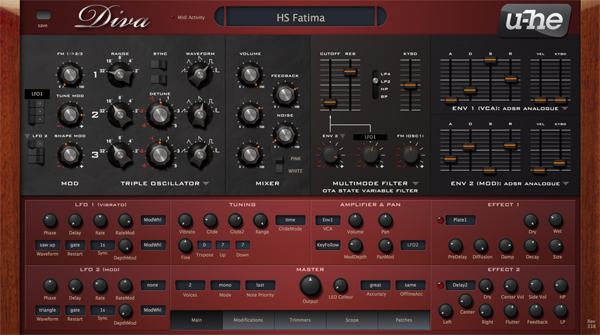
DIVA - Beta 472 Dec 15th --> http://www.kvraudio.com/forum/viewtopic.php?t=302792

Berlin Modular - Bazille 0.4 --> http://www.kvraudio.com/forum/viewtopic.php?t=258683
