
Contact Microphones
Moderator: snailed
-
user_4595
Contact Microphones
I'm working on a project that involves five contact microphones that need to be combined into one signal, which will then go to an amplifier. A large mixer is out of the question, I need something small (preferably hand-held). Any suggestions would be much appreciated, thanks

-
the_semen_incident

- Posts: 321
- Joined: Sat May 10, 2008 7:45 pm
- Location: Huntsville, AL
If you don't need volume control, you can just have them all going to a passive with five jacks and a single out... I've never had sound issues doing that...
Better yet, you could just connect each mic's +/- wires to a single jack's +/- lugs...Put some type of rubber cement or something on it and it's like a whip made of contact mics... I actually might like to try this...
Also, you can just buy a cheap mixer... Behringer makes a really small 4 channel mixer (small enough to grip in one hand, and DOD made mixers similar to those, but I've never used one....
Better yet, you could just connect each mic's +/- wires to a single jack's +/- lugs...Put some type of rubber cement or something on it and it's like a whip made of contact mics... I actually might like to try this...
Also, you can just buy a cheap mixer... Behringer makes a really small 4 channel mixer (small enough to grip in one hand, and DOD made mixers similar to those, but I've never used one....
-
user_4649
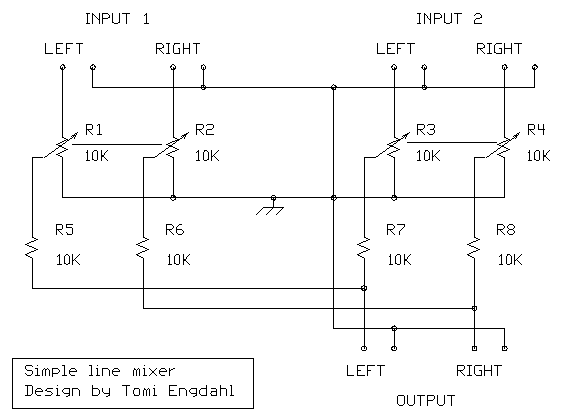
I think it's better to first solder the output of each contact mic to their own resistor (like R5 through R8 in hatta's schematic) and then connect the five other ends of the resistors together and connect that to the output.thesemenincident wrote:If you don't need volume control, you can just have them all going to a passive with five jacks and a single out... I've never had sound issues doing that...
I don't really know why, but Nicolas Collins advices to do it like that in his book The Art of Hardware Hacking (http://www.amazon.com/Handmade-Electron ... 0415975921" onclick= "window.open(this.href);return false;). I think if you put the resistors in between, the signal from one contact mic will not go into the other mics but instead go to the output because that way the resistance is lower. So I guess the signal will be better that way than without resistors.

Re: Contact Microphones
I'm tired of building my own cheap contact mics only to have them fail at inopportune times. I'm looking for a good contact mic with as wide of a frequency range as possible; STURDY with a 1/4inch out. Any suggestions?

Re: Contact Microphones
You might look into the K & K stuff.
I also bought a film tab from:
http://contactmicrophones.com/
but it really seemed like it needed a buffer and preamp. Of course, stupid fuck that i am, i ripped the film tab before i could even do much with the mic. The tabs rip very easy. I also see that she has the large diameter disks, I am not sure if they are as big as the big ass piezo disk i used to get at allelectronics.com.
I have had better luck making my own w/o plasti-dip. but using a blob of silicon or whathaveyou on the back of the mic where the solder joint is (i leave the brass side as is now, i like it better that way). That seems to help the thing stay together. The other thing that helps is flux. I have a tub of flux and i flux the everything before i solder. Though iffin you are sloppy and use too much and the flux don't all burn off you end up with a sticky microphone.
Sometimes you can see manufactured ones sold as drum triggers at the big box retailers too. Same-same.
-kp--
I also bought a film tab from:
http://contactmicrophones.com/
but it really seemed like it needed a buffer and preamp. Of course, stupid fuck that i am, i ripped the film tab before i could even do much with the mic. The tabs rip very easy. I also see that she has the large diameter disks, I am not sure if they are as big as the big ass piezo disk i used to get at allelectronics.com.
I have had better luck making my own w/o plasti-dip. but using a blob of silicon or whathaveyou on the back of the mic where the solder joint is (i leave the brass side as is now, i like it better that way). That seems to help the thing stay together. The other thing that helps is flux. I have a tub of flux and i flux the everything before i solder. Though iffin you are sloppy and use too much and the flux don't all burn off you end up with a sticky microphone.
Sometimes you can see manufactured ones sold as drum triggers at the big box retailers too. Same-same.
-kp--

Re: Contact Microphones
I use and recommend the belkin rockstar, a small (fits nicely into your palm) device with 5 female 1/8th inch in/out-puts and 1 male of the same, this reacts to what you plug int it automatically and appropriately, say 4 headphones and 2 iPods, or 5 cd players and one line to the PA, or a laptop, a MD player (with a telephone mic on it, feeding back on itself), and a dictaphone, going to a couple of sets of speakers, which have both been prepared seperately with grains and tinsel....
I picked these up for a bike tour, but I never use a proper mixed anymore... Though they do dcrease the output exponentially with each additional input source.
I picked these up for a bike tour, but I never use a proper mixed anymore... Though they do dcrease the output exponentially with each additional input source.
-
cheapmachines
- Posts: 264
- Joined: Wed May 14, 2008 5:43 pm
- Location: London
- Contact:
Re: Contact Microphones
There are various brands that manufacture 8 channel mono mic signal mixers like this one:
http://www.cybermarket.co.uk/ishop/923/shopscr876.html
... could be small enough for what you're doing. They run off a wall-wart power supply or 9v battery. I have one that I don't use anymore, PM me if you're interested...
The Crank contact mics are very sturdy (ugly as hell too) and terminate in a 1/4" jack:
http://www.noiseguide.com/product_info/ ... ontact_mic
Much higher output than anything else I've tried... almost too much in some cases.
http://www.cybermarket.co.uk/ishop/923/shopscr876.html
... could be small enough for what you're doing. They run off a wall-wart power supply or 9v battery. I have one that I don't use anymore, PM me if you're interested...
The Crank contact mics are very sturdy (ugly as hell too) and terminate in a 1/4" jack:
http://www.noiseguide.com/product_info/ ... ontact_mic
Much higher output than anything else I've tried... almost too much in some cases.
-
onthestrip
- Posts: 20
- Joined: Wed Dec 24, 2008 7:36 pm
Re: Contact Microphones
I've heard positive reviews of Crank Sturgeon's mics as well, but never used them myself. But he uses them himself and if they can take his abuse, I'd say they're good enough for anyone .. recently I came across http://www.getlofi.com/?page_id=1472 , don't know how sturdy those are. Let me know what you find out, I'm getting sick of making unreliable stuff myself as well 

Re: Contact Microphones
I recently got a K&K contact mic ("Big Shot" model, I believe) for doing field recordings based on Joe Foster's recommendation in another thread.
I have been enjoying getting to know all sorts of surfaces, but I'm wondering if anyone has tips to share in achieving the best recording. Holding it on with a finger, I can often find a good position for it, but the slight movement of my hand gets on the recording. I've just been using bits of packing tape over the top of it to hold it onto places, but I'm having a bit of trouble attaching it well enough (tight enough?) to get the best sound (especially for lower frequencies). Plus, I pick up the frequent clicks of the tape slowly coming undone.
I probably just need to experiment more, but any hints would be appreciated.
I have been enjoying getting to know all sorts of surfaces, but I'm wondering if anyone has tips to share in achieving the best recording. Holding it on with a finger, I can often find a good position for it, but the slight movement of my hand gets on the recording. I've just been using bits of packing tape over the top of it to hold it onto places, but I'm having a bit of trouble attaching it well enough (tight enough?) to get the best sound (especially for lower frequencies). Plus, I pick up the frequent clicks of the tape slowly coming undone.
I probably just need to experiment more, but any hints would be appreciated.


Re: Contact Microphones
Traditional methods for attaching contact mics are double sided tape (though this can cause unpeeling sounds if it's not strong enough) or preferably some sort of clamp.
here's a snap from jgrzinich's blog

here's a snap from jgrzinich's blog
Re: Contact Microphones
I'll throw in a recommendation out for the Trauma Tone mics made by Ryan Bloomer (aka Flatline Construct).
http://traumatone.blogspot.com/
These are beasts. Check out the video of the heavy duty model's "torture" test: http://www.youtube.com/watch?v=uoDUeANI8PE
I just picked up a "Black Mass" ($35) which is the mid range model between his standard mics ($20/2 for $35) and the heavy duty model ($45), which is more intense than I'll likely ever need. As well done as the Crank Sturgeon models - six month guarantee - with cleaner aesthetics. No offense to my buddy Crank.
http://traumatone.blogspot.com/
These are beasts. Check out the video of the heavy duty model's "torture" test: http://www.youtube.com/watch?v=uoDUeANI8PE
I just picked up a "Black Mass" ($35) which is the mid range model between his standard mics ($20/2 for $35) and the heavy duty model ($45), which is more intense than I'll likely ever need. As well done as the Crank Sturgeon models - six month guarantee - with cleaner aesthetics. No offense to my buddy Crank.

Re: Contact Microphones
mshiflet wrote:I'll throw in a recommendation out for the Trauma Tone mics made by Ryan Bloomer (aka Flatline Construct).
http://traumatone.blogspot.com/
These are beasts. Check out the video of the heavy duty model's "torture" test: http://www.youtube.com/watch?v=uoDUeANI8PE
I just picked up a "Black Mass" ($35) which is the mid range model between his standard mics ($20/2 for $35) and the heavy duty model ($45), which is more intense than I'll likely ever need. As well done as the Crank Sturgeon models - six month guarantee - with cleaner aesthetics. No offense to my buddy Crank.

Thanks Mike!!!
classically trained
Re: Contact Microphones
Yeah, she's a beauty.yonhosago wrote:
Re: Contact Microphones
That looks pretty great, I'm thinking of picking one up. Thanks, Mike.
For some reason I can't find the "high end" version on that page. Just the $35 one... search function isn't working so well I guess?
For some reason I can't find the "high end" version on that page. Just the $35 one... search function isn't working so well I guess?
Re: Contact Microphones
Maybe he sold out and removed the posts? They were up there as of a week or so ago, but gone now.
Here's a Google cache: http://74.125.95.132/search?q=cache:b5N ... =firefox-a
Hmmm... I guess you have to subscribe to the RSS and be on the ball to get these. I knew his noise-making devices were limited, but figured he was cranking out the contact mics at a higher rate.
Here's a Google cache: http://74.125.95.132/search?q=cache:b5N ... =firefox-a
Hmmm... I guess you have to subscribe to the RSS and be on the ball to get these. I knew his noise-making devices were limited, but figured he was cranking out the contact mics at a higher rate.
-
visa tapani
- Posts: 115
- Joined: Sun May 11, 2008 4:49 pm
- Location: London, UK
Re: Contact Microphones
Is it possible to use a contact mic with a handheld portable recorder, such as the Olympus LS-10 that I have? I've heard that since the piezos tend to have high impedance, you'd need a DI box to get a full frequency response. What experience do IHMers have, is a DI box necessary? My Olympus LS-10 has a 2kohm mic input and a 78kohm line-in input, so I wonder if one of these would suffice? Do contact mics differ greatly in their impedance and/or their need for a DI-box?
At K&K Sound they recommended me a preamp for this application, but that would make my mobile recording rig less mobile (and also more expensive)...
Also, are there stereo contact mic sets available - something like this, but with stereo output and a preferably a 3,5mm plug cable? Or could I just take any two piezos and solder them to a 3,5mm stereo plug to achieve that?
At K&K Sound they recommended me a preamp for this application, but that would make my mobile recording rig less mobile (and also more expensive)...
Also, are there stereo contact mic sets available - something like this, but with stereo output and a preferably a 3,5mm plug cable? Or could I just take any two piezos and solder them to a 3,5mm stereo plug to achieve that?
Re: Contact Microphones
Yes, you can record straight to a portable recorder. I've never tried a DI but i guess it could give you a better freq. response (?) They tend to work fine in most MIC inputs I've tried, just make sure the Phantom is OFF - sending 48v to a piezo can make it behave more like a transducer.
As for a preamp - I guess that depends what you're recording, I have used a portable mixer in the past and then recorded at line level and actually thinking back I did get pretty nice results from doing it that way, but it's far from essential.
Solder up your own stereo pair to start, that's exactly what they will have done, so it seems crazy to pay for labour on your first pair of contact mics.
As for a preamp - I guess that depends what you're recording, I have used a portable mixer in the past and then recorded at line level and actually thinking back I did get pretty nice results from doing it that way, but it's far from essential.
Solder up your own stereo pair to start, that's exactly what they will have done, so it seems crazy to pay for labour on your first pair of contact mics.
-
visa tapani
- Posts: 115
- Joined: Sun May 11, 2008 4:49 pm
- Location: London, UK
Re: Contact Microphones
Thanks a lot Stephen.
I was previously planning to get a pair of the K&K Big Shots for multi-use piezos, but those Crank contact mics are quite a bit cheaper. Are the Cranks simply a better deal or are the K&K mics superior in quality?
I was previously planning to get a pair of the K&K Big Shots for multi-use piezos, but those Crank contact mics are quite a bit cheaper. Are the Cranks simply a better deal or are the K&K mics superior in quality?