These Shakespeare notes heavily involve three versions of the plays, so I'll take the unusual step of posting them in both forums.
Hope you are all safe and suffered no losses from the fires!
Emily and Joe were evacuated from their home in Bennett Valley, and have moved to the safety of our brother's house. Our son lives on Coffey Lane(!), had been staying with our daughter and is now back at his place, which somehow survived.
To understand Richard III, Auden directs us to Hitler's speech to his general staff, 1939, a week or so before invading Poland. An excerpt: "Essentially all depends on me, on my existence, because of my political talents. Furthermore, the fact that probably no one will ever again have the trust of the whole German people as I have. There will probably never again in the future be a man with more authority than I have. My existence is therefore a factor of great value.” Why does that so readily bring to mind the unhinged grandiosity of the current inmate in the White House?
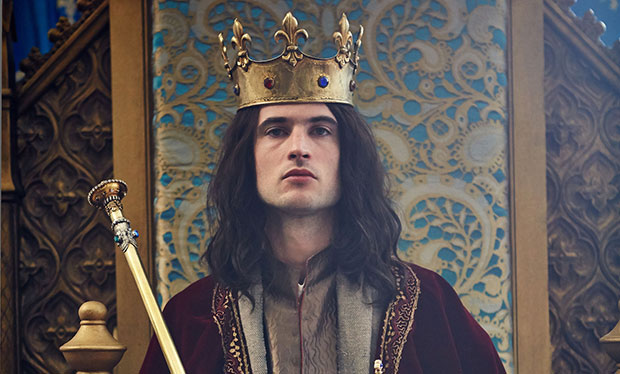
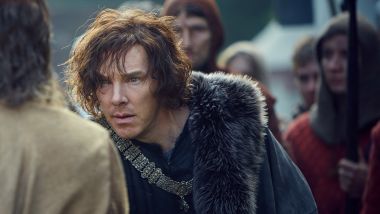
I have used some of the time of my unexpected week off from calling to watch three excellent versions of RIII – Olivier (1955, traditional, in vivid pageantry Technicolor!), McKellen (1995, set in a counterfactual 1930s Nazi England), and Cumberbatch (2016, BBC, conclusion of a series including the three HVI plays, traditional staging in historical settings). I will use the films here as perspectives on a couple of the play's themes.
A prefatory note on history: as was noted the first time around, the historical Richard did not commit all the crimes attributed to him in this play. Also, Will uses massive time-compression here, for the sake of moving the play along, which completely distorts the historical time-line: Richard served successfully for twelve years as administer of the northern territories for his brother, King Edward, and he reigned as King for two years, not the bloody couple of weeks in the play. Shakespeare adhered to the Tudor version of history, a prudent stance since RIII's conqueror in Act V (Richmond, later HVII) was Queen Elizabeth's grandfather. Josephine Tey's novel, The Daughter of Time, finds her detective recuperating in the hospital and delving into the case of RIII's real and imagined crimes. The title is derived from the Latin proverb translated as "Truth is the daughter of time."
And a couple of miscellaneous notes:
RIII is the longest play in the canon except for Hamlet.
The words “mother,” “children,” and “dream” appear in this play more frequently than anywhere else in the canon.
Composer William Walton provides the sound track for the Olivier version, and the cast includes Ralph Richardson (Olivier really wanted Orson Welles to play Buckinghan, and was dissatisfied with Richardson's performance), Cedric Hardwick, John Gielguld and Claire Bloom.
HOW TO PLAY RICHARD? There have to be certain commonalities, basic givens: viciousness, calculation, a dry wit (which abandons him late in the play, more on this later), a deep resentment at the physical body nature has cursed him with, a charismatic confidence in his abilities to dissemble and conquer, an energetic and enthusiastic sadism . . .
Olivier's Richard is the coldest of the three, seemingly invulnerable, conveying an aggressive sense of entitlement neither of the other versions has. McKellen's Richard (as a haughty, British aristocrat) is also icy throughout, but not as overtly brash as Olivier, and burdened by the sense of being too tightly wound, showing cracks around the edges. Cumberbatch's Richard is by far the most sympathetic I have ever seen, openly sharing vulnerabilities with the audience, clearly affected by the slights of others, capable of suffering. I found it a refreshingly entertaining interpretation.
As with Macbeth, the villain in this play is immeasurably more interesting than any of the good guys.
Auden notes that the three early arch-villains of the London theater – Marlowe's Barabas, RIII, and Aron (from Titus Andronicus) – are a Jew, a hunchback, and a Moor, "all outside the norm;" or, as we might say today, all easy targets for Othering.
THE WOMEN OF RICHARD III
I think we can all agree that coming to RIII after having done the three HVI plays immediately preceding it gives one a greater appreciation of the women of RIII, who can too often be dismissed as the four crazy old queens. Bloom doesn't give them much more than that, opining that “none of the women's parts are playable.” Bloom goes on to say that in Juliet and later characters Shakespeare takes women's roles to new heights, but “no one could surmise that on the basis of Richard III.”
All three films give more space to the women that is often accorded them in productions, but they vary widely. The BBC (Cumberbatch) version, which follows the women through the earlier plays, gives them extensive space. Margaret – here in her fourth consecutive history play – is reduced to a kind of revenant of an earlier age, a ritual curser , chorus, and prophetess of doom. The other queens have distinct personalities and functions in the play, and with their collective meeting in Act IV they seem to form a cohesive anti-Richard sisterhood. The film's final shot is of a crazed Margaret wandering among hundreds of bodies on Bosworth field, as the camera pans up and away from the ground.
Margaret is completely left out of the other two productions. McKellen casts Maggie Smith as the Duchess of York (folding some of Margaret's lines into the part), Annette Bening as Queen Elizabeth, and Kristin Scott Thomas as Lady Anne. The women are visible throughout in McKellen's version.
Olivier film has considerably less of a women's presence than the other two versions; and yet, at the time, Olivier was noted for giving the women more lines in the play than they were typically getting at the time. Claire Bloom's Anne seems genuinely taken with Richard in I, ii, after his ruse of offering to let her kill him , but the scene still seems of a bit a stretch. The other versions seem even less credible to me. The first time I read Richard III was in 1970, with The Birnham Wood Company in San Francisco, and we all stopped and said, “Too fast!” at the scene's conclusion – I'm not sure I've changed my mind since.
RICHARD LOSES HIS MOJO -- Most analyses of the play see Richard losing his confidence and his wit shortly after the time he is crowned, and each of the films deals with this in a different way. With Cumberbatch being the most visibly vulnerable of the Richards, his fall is the easiest to track. His last overtly sly witticism comes during that deliciously devilish Act III, scene 7, in which Richard creates an elaborately staged fake event in collaboration with Buckingham and Catesby to get the Lord Mayor of London and the Alderman to insist that he become king despite his supposed protestations against having to do it. In pretending to yield to the crowd, Cumberbatch plays the line “I am not made of stones” directly to audience, clearly ironically and laughing at the dupes who imagine that they have persuaded him to be king. But that is his last laugh with us. Shortly after this, he is crowned, orders Buckingham to murder the princes in the tower, and is frustrated and furious that Buckingham balks at this. The dark mood deepens, unrelieved by his wit. An accompanying non-verbal sign of his deterioration is his chessboard – Cumberbatch's Richard plays chess constantly throughout the play, sitting at right angles to the pieces and playing both sides. (Mercifully, they have the board set up correctly in the film, with white squares in the lower right-hand corners.) But after his coronation, he does not make moves, he only clicks the marble pieces incessantly and annoyingly against the board.
McKellen's ice turns hot at that scene when Buckingham balks at killing the princes, and he never again regains the cool command of earlier scenes. He becomes overtly emotional at his mother's cursing of him, and meets a fiery death in the end that evokes James Cagney's “top of the world, ma!' moment, falling from a height into flames, Al Jolson crooning “I'm sitting on top of the world” as the closing credits start to roll.
Olivier's descent is the least visible. His humor throughout is mean-spirited and of a piece with his sadism, intended for himself and only incidentally shared with the audience. He maintains his privileged air of entitled authority throughout. The closest he comes to genuine emotion is his barely contained joy at his coronation, and yet contain it he does. The film includes a striking non-verbal exchange between Richard and Buckingham – after the coronation, Buckingham goes to embrace Richard, as he has when celebrating their previous triumphs. But this time Richard offers his hand to be kissed. After recovering himself, Buckingham reaches for the hand, and Richard lowers it so Buckingham has to kneel to kiss it. Brilliant!
Olivier's Richard first shows weakness on the eve of the battle, V, iii, saying, “I have not that alacrity of spirit/ Nor cheer of mind that I was wont to have.” Then follows his bad dreams, his murder victims visiting him and ordering him to “despair and die.”
By morning, Olivier's Richard declares, "Richard's himself again," spoken to the camera on the morning of the battle of Bosworth. The line is not by Shakespeare, but comes from an acting edition of Shakespeare's text by Colley Cibber (1671-1757). Cibber's rewrite of the play was the primary stage version from 1700 to the late 1800s.
We're still scheduled for Wednesday, November 8, three days after Rita and I return from Antwerp, Amsterdam, Rouen, Hanfleur, London, and Bath. Hope to see you there, and safe journeys!
Steve
Here's a couple from the Shangri-Las, The Mymidons of Melodrama:
https://www.youtube.com/watch?v=9YrH_imO6kg
https://www.youtube.com/watch?v=SC4NmZSlDeY