
Hard Rain Falling - Don Carpenter
Kind of pulpy, like Kerouac stripped of all sentiment and Romanticism, or maybe Henry Miller if he was hustling pool halls in Portland Oregon in the 60s.
It is currently Thu Aug 27, 2026 8:07 am
Moderator: michael
This sounds just great, and I guess anything kissed by Pelecanos has got me at hello. Plus my hit-to-miss with NYRB Classics is pretty solid, and I might be up to ~25 of them by now. Maybe it's just the graphic design and the whole "series" appeal? I'm a consumer! Read this one recently, and it was more or less nuts, but kept me riveted:surfer wrote:
Hard Rain Falling - Don Carpenter
Kind of pulpy, like Kerouac stripped of all sentiment and Romanticism, or maybe Henry Miller if he was hustling pool halls in Portland Oregon in the 60s.

Starting in 1970, Jean Genet—petty thief, prostitute, modernist master—spent two years in the Palestinian refugee camps in Jordan. Always an outcast himself, Genet was drawn to this displaced people, an attraction that was to prove as complicated for him as it was enduring. Prisoner of Love, written some ten years later, when many of the men Genet had known had been killed, and he himself was dying, is a beautifully observed description of that time and those men as well as a reaffirmation of the author's commitment not only to the Palestinian revolution but to rebellion itself. For Genet's most overtly political book is also his most personal—the last step in the unrepentantly sacrilegious pilgrimage first recorded in The Thief's Journal, and a searching meditation, packed with visions, ruses, and contradictions, on such life-and-death issues as the politics of the image and the seductive and treacherous character of identity. Genet's final masterpiece is a lyrical and philosophical voyage to the bloody intersection of oppression, terror, and desire at the heart of the contemporary world.
And this one I'm in the middle of right now! Love this guy.surfer wrote:
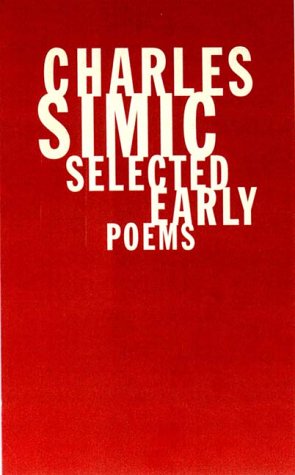
Charles Simic: Selected Poems 1963-1983
I'm with you, although I've probably read closer to ten, but I find them really reliable and they turn me onto writers/books I've never heard of before quite a bit.kscotthandley wrote: Plus my hit-to-miss with NYRB Classics is pretty solid, and I might be up to ~25 of them by now. Maybe it's just the graphic design and the whole "series" appeal? I'm a consumer!
The design reminds me of the old Peguin series. Just a photo taking up the whole sleeve and simple text:kscotthandley wrote:This sounds just great, and I guess anything kissed by Pelecanos has got me at hello. Plus my hit-to-miss with NYRB Classics is pretty solid, and I might be up to ~25 of them by now. Maybe it's just the graphic design and the whole "series" appeal? I'm a consumer!surfer wrote:
Hard Rain Falling - Don Carpenter
Kind of pulpy, like Kerouac stripped of all sentiment and Romanticism, or maybe Henry Miller if he was hustling pool halls in Portland Oregon in the 60s.

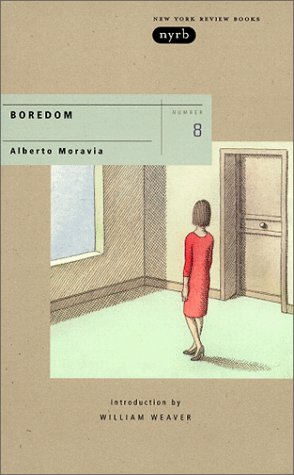
I've read 4 of Moravia's books: Contempt, Boredom, Conformist, Woman of Rome (the later two from the excellent Steerforth Italia series - great design and paper quality too) with the first two maybe slightly above the later two, but not by much. Contempt you probably know, Boredom (1960) is about a young bourgeois painter who has an affair with one of his models and gradually becomes obsessed with her, while suffering through ennui-caused painter's block. Its very "Antonioni". Very little plot, characters ruminating on the fundamental pointlessness of any endeavor. Conformist (1951) from is about a Fascist bureaucrat who is ordered to kill a former professor. and Women of Rome (1947) is about a poor young peasant woman who stumbles into prostitution and theft, and has a series of men (representing different political ideologies and backgrounds) come into and out of her life. He seems to be a writer of uniformly high quality. I also have a stunning short story which may be one of Moravia's most personal works, a novella from 1944 called "Agostino" which was included in William Weaver's outstanding collection of post WWII Italian writers, Open City (also from Steerforth Italia). It is well worth seeking out, not just for the Moravia story, but also includes excerpts from Bassani's Finzi-Continis, Silone's Bread and Wine, Elsa Morante (Moravia's wife and an excellent writer herself), Emillio Gadda's Awful Mess on the Via Merulana*, and a few others. "Agostino" concerns a young boy coming of age, and his complex relationship with his single mother. Its a wonderful work, different in its way from his later works, more aligned with classic Italian neo-realism. The collection also includes an extended and very moving and insightful introduction / memoir by Weaver, who drove ambulances in Naples during WWII, and then moved to Rome after the war and became close friends with all these writers.kscotthandley wrote: I wonder if anybody knows his body of work well enough to name a kind of "consensus best" or even just a personal favorite of all his books?
http://www.jonathanrosenbaum.com/?p=6389One of my favorite Italian novels, long out of print in English, is Carlo Emilio Gadda’s That Awful Mess on Via Merulana, a sort of Roman police procedural from 1946 in which the central crime never gets solved. The book is so beloved in Italy that it’s known simply as Il pasticciaccio (”the awful mess”), and when Gadda died in 1973 at the age of 79, it had gone through several editions.
William Weaver, who did the 1965 English translation, wrote in the preface that “Il pasticciaccio occupies in contemporary Italian literature the position that Ulysses, Remembrance of Things Past, and The Man Without Qualities occupy in the literature of their respective countries.” He also noted that many of Gadda’s other fictional works are “unfinished, but not incomplete. Even the briefest of Gadda’s fragments has its own curious wholeness; and if the ‘murder story’ aspect of Il pasticciaccio remains unresolved, one feels — at the end of this long, apparently ambling work — that it is better not to know who is responsible for the death of Signora Liliana. The reader feels that he has probed deeply enough already into the evil and horror of the world and that yet another, worse revelation of it would be more than the reader, the author, and the protagonist [Detective] Ingravallo could bear. Though students of Gadda’s work might not agree, one also suspects that his novels were born to be fragments, like certain imaginary ruins in Venetian painting, perfect parts of impossible wholes.”
I too am a fan of the series, may I recommend the following?jon abbey wrote:I'm with you, although I've probably read closer to ten, but I find them really reliable and they turn me onto writers/books I've never heard of before quite a bit.kscotthandley wrote: Plus my hit-to-miss with NYRB Classics is pretty solid, and I might be up to ~25 of them by now. Maybe it's just the graphic design and the whole "series" appeal? I'm a consumer!


just read this, really loved it. I'm a total sucker for this kind of mid-century, noir-ish, straightforward writing, especially when it occasionally touches on deeper themes. this one is more than a genre novel, though, really well structured (the initial chapter describing the main character's parents is like the kind of obligatory opening chapter of every bio, except this one is actually interesting).surfer wrote:
Hard Rain Falling - Don Carpenter
Kind of pulpy, like Kerouac stripped of all sentiment and Romanticism, or maybe Henry Miller if he was hustling pool halls in Portland Oregon in the 60s.