
Currently Reading
Moderator: michael

Re: Currently Reading
The assertion is "smarter", and every measurement available to research indicates that is so.
http://crowwithnomouth.wordpress.com/
Experimental music should be something that suggests a way of organizing your thinking, your attitude toward the world, which suggests that the world could be different.
Christian Wolff 2014
Experimental music should be something that suggests a way of organizing your thinking, your attitude toward the world, which suggests that the world could be different.
Christian Wolff 2014

Re: Currently Reading
Finished re-reading all of Underworld (wasnt planning on it, but it was worthwhile, imo)
NR:

Cesar Aira - Ghosts
NR:
Cesar Aira - Ghosts

Re: Currently Reading
Yes, but surely you know that measurements of intelligence are piss-poor. After all, James Flynn found dramatic IQ gains from 1900-1994, so much so that IQ tests were frequently recalibrated during that time to keep the average at 100. I can't find data for 1994-present, but either way, the message of Flynn's work wasn't necessarily that people were getting smarter; rather, he concluded that IQ tests likely have only a weak correspondence to intelligence (whatever that means).Jesse wrote:The assertion is "smarter", and every measurement available to research indicates that is so.
I certainly accept that people's intelligence is changing, but again, that's always already been the case.
You, of all people, should understand

Re: Currently Reading
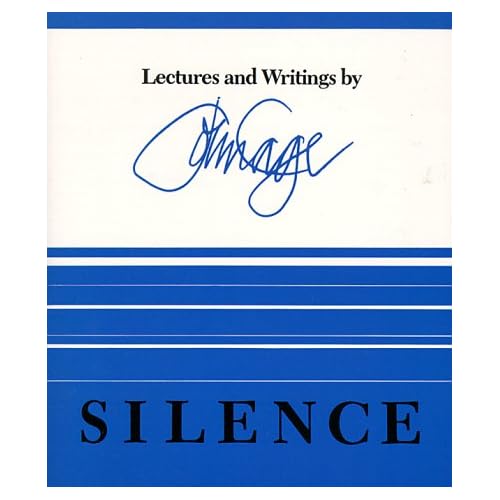
john cage - silence
Re: Currently Reading
Joe, with all respect, you're the educator, I don't know shit about IQ testing.
I have two sons (20 and 26), raised them from 2 and 8 as a single parent, meaning I spent a bazillion hours in their world, amongst their peerage, in their schools, hosting and chaperoning, blah, blah. That's just to say (as I began my post about the conversation with my 20 y.o.) my perspective is anecdotal/experiential. I'm not sure my peers at their age could identify who Israel's neighbors were, but they would have fared better on Jaywalking.
I have two sons (20 and 26), raised them from 2 and 8 as a single parent, meaning I spent a bazillion hours in their world, amongst their peerage, in their schools, hosting and chaperoning, blah, blah. That's just to say (as I began my post about the conversation with my 20 y.o.) my perspective is anecdotal/experiential. I'm not sure my peers at their age could identify who Israel's neighbors were, but they would have fared better on Jaywalking.
http://crowwithnomouth.wordpress.com/
Experimental music should be something that suggests a way of organizing your thinking, your attitude toward the world, which suggests that the world could be different.
Christian Wolff 2014
Experimental music should be something that suggests a way of organizing your thinking, your attitude toward the world, which suggests that the world could be different.
Christian Wolff 2014

Re: Currently Reading
Joe has much more exposure to high school/college age kids than I do, but I do know that it's way more difficult to get into top colleges now than it was 25 years ago when I was applying.

Re: Currently Reading
I'd say kids are definitely not becoming dumber, quite the reverse, I myself have fathered a genius or two  But they have it harder to achieve geekdom, or any other kind of beneficial weirdness, which means they'd have to come into their own the long way while we give them less and less time. The kids I know are much more capable, but they don't seem to have hidden treasures, which I find kind of sad, but then that's just sentimental . . .
But they have it harder to achieve geekdom, or any other kind of beneficial weirdness, which means they'd have to come into their own the long way while we give them less and less time. The kids I know are much more capable, but they don't seem to have hidden treasures, which I find kind of sad, but then that's just sentimental . . .
Re: Currently Reading
What I've heard about this is that, in prior years, these schools looked for well-rounded students (excellent grades, a letter in some sport, community service, maybe an award in something artsy). But now, they want well-rounded CLASSES. That means no individual kid can be well-rounded, since each has to be an Olympic medalist in something or a Pulitzer Prize winner. The class as a whole has everything, but each kid has to be a freak.jon abbey wrote:Joe has much more exposure to high school/college age kids than I do, but I do know that it's way more difficult to get into top colleges now than it was 25 years ago when I was applying.
Or from Namibia.
"Freedom of thought and speech without available means of gaining information and methods of sound analysis, are empty. Protection and security are meaningless until there is something positive worth protecting." E.W. Hall
Re: Currently Reading
also, the number of applications is way up for roughly the same number of spots. I got roped into doing a couple of alumnus interviews for Columbia a while back, and one of the kids I interviewed was the valedictorian of his high school class, good boards, captain of the basketball team, he was rejected.

Re: Currently Reading
I haven't read this book, but I've read some of the articles and heard lectures from some of the other modern luddites. While there is definitely a decline in certain areas of knowledge in the current generation (and it is general knowledge these are all going on about, not raw intelligence per se) they almost always commit some logical fallacy in their rush to blame the internet. People do read less books today (and newspapers &c) but internet communication is still almost entirely text, which last time I looked involved reading. These books also tend to ignore the facts that there doesn't seem to be such a decline universally across western countries (to compare apples more or less). Last I checked Japan, Germany, Korea, etc all have the internet and seem to be kicking US students asses as far these general knowledge tests go. Its been the same story since probably radio and personally I think that TV has been far more detrimental then any other technology - it is by far the most prevalent and the most passive. I do think that things like texting and twittering are fostering our short attention span culture, but TV got us there first.
The millennials sure do seem dumb, but hell I'm just a cynical old gen x-er so feel free to write off my opinions. The total self-absorption of the baby-boomers is going to completely gut American long, long before the mellennials get a chance establish any sort of idiocracy.
The millennials sure do seem dumb, but hell I'm just a cynical old gen x-er so feel free to write off my opinions. The total self-absorption of the baby-boomers is going to completely gut American long, long before the mellennials get a chance establish any sort of idiocracy.
"Please everybody, if we haven't done what we could have done, we've tried"
Re: Currently Reading
This is not the case (and an area about which I know quite a bit--it's a big part of my job)walto wrote:What I've heard about this is that, in prior years, these schools looked for well-rounded students (excellent grades, a letter in some sport, community service, maybe an award in something artsy). But now, they want well-rounded CLASSES. That means no individual kid can be well-rounded, since each has to be an Olympic medalist in something or a Pulitzer Prize winner. The class as a whole has everything, but each kid has to be a freak.jon abbey wrote:Joe has much more exposure to high school/college age kids than I do, but I do know that it's way more difficult to get into top colleges now than it was 25 years ago when I was applying.
Or from Namibia.
You, of all people, should understand

Re: Currently Reading
that's very fair, but at the same time i can't help feeling that on some level public discourse has coarsened, which is reflected in popular culture and politics. certainly, i think there's more and cheaper distractions now, and even a lot of nixon's social programs are sadly quite progressive by today's standards. while attitudes have, in many ways, liberalized (according to polls), people seem a lot more tolerant or oven unaware of horrible, horrible policies (see USA 2000-2008) and popular culture feels like it's increasingly targeted to 13-17 year olds.faster wrote:My problem with the "kids are dumb" argument is that it forgets just how fucking dumb kids were a couple generations ago, too. I'm 36, didn't have the Internet until after college, and my generation is full of complete morons. The assertion that at some point in the past people were smart just doesn't ring true.
what measurements are these, though? i know IQ's go up every year (which joe hinted at - here's the big wiki on "the flynn effect" - http://en.wikipedia.org/wiki/Flynn_effect), which probably has something to do with health and childhood nutrition (and interestingly, there's evidence these gains are clustered at the bottom end of the curve, so the smart and really getting smarter, the dumb are just getting less dumb), though the article also notesJesse wrote:The assertion is "smarter", and every measurement available to research indicates that is so.
Still another theory is that the general environment today is much more complex and stimulating. One of the most striking 20th-century changes in the human intellectual environment has come from the increase in exposure to many types of visual media. From pictures on the wall to movies to television to video games to computers, each successive generation has been exposed to far richer optical displays than the one before and may have become more adept at visual analysis.
this is certainly true, but i'd be extraordinarily hesitant to connect it to any assertions about intelligence. it probably has a lot more to do with population growth, shifts in the US economy towards jobs that require college degrees, the easier availability of credit, and the opening of selective school admissions towards more minorities. i haven't researched this, but i also wouldn't be surprised if more women are applying to college these days too, and i know that there are currently more women getting college degrees than men. hell, as long as we are talking about joe's experience, i bet international applications are up too.jon abbey wrote:Joe has much more exposure to high school/college age kids than I do, but I do know that it's way more difficult to get into top colleges now than it was 25 years ago when I was applying.
this is DEEPLY pedantic, but i can't resist the irony, i'm sorry: it should be "fewer" books.hatta wrote:I haven't read this book, but I've read some of the articles and heard lectures from some of the other modern luddites. While there is definitely a decline in certain areas of knowledge in the current generation (and it is general knowledge these are all going on about, not raw intelligence per se) they almost always commit some logical fallacy in their rush to blame the internet. People do read less books today (and newspapers &c) but internet communication is still almost entirely text, which last time I looked involved reading.
going to?The total self-absorption of the baby-boomers is going to completely gut American long, long before the mellennials get a chance establish any sort of idiocracy.
it, fairly, got overshadowed by other things, but an important symbolic part of obama's election for me was that he was the first post-boomer president. ahhhhh. . .
-jesse
Re: Currently Reading
faster wrote:This is not the case (and an area about which I know quite a bit--it's a big part of my job)walto wrote:What I've heard about this is that, in prior years, these schools looked for well-rounded students (excellent grades, a letter in some sport, community service, maybe an award in something artsy). But now, they want well-rounded CLASSES. That means no individual kid can be well-rounded, since each has to be an Olympic medalist in something or a Pulitzer Prize winner. The class as a whole has everything, but each kid has to be a freak.jon abbey wrote:Joe has much more exposure to high school/college age kids than I do, but I do know that it's way more difficult to get into top colleges now than it was 25 years ago when I was applying.
Or from Namibia.
So....what IS the scoop?
"Freedom of thought and speech without available means of gaining information and methods of sound analysis, are empty. Protection and security are meaningless until there is something positive worth protecting." E.W. Hall
-
leroysghost

- Posts: 1070
- Joined: Wed Jul 15, 2009 10:30 pm
- Location: Lovecraft Country
Re: Currently Reading
jkudler wrote: this is DEEPLY pedantic, but i can't resist the irony, i'm sorry: it should be "fewer" books.
nice catch!
as stupid millennial kid myself, i've been corrected this way quite often so now i appreciate seeing it done to others

this is also pedantic, but Obama is a baby boomer (baby boom = 1946-1964 and Obama was born in 1961).jkudler wrote: it, fairly, got overshadowed by other things, but an important symbolic part of obama's election for me was that he was the first post-boomer president. ahhhhh. . .
torn, toiled and troubled
Re: Currently Reading
I liked this book pretty well, but I really really loved Aira's book How I Became a Nun. The range between these two works is remarkable and "Nun" is simply wild. Each chapter is great and it's nearly impossible to imagine that they all refer to the same character(s). Not to mention that the book is a (short) shaggy dog story. Amusing and compelling.surfer wrote: NR:
Cesar Aira - Ghosts
Apparently the only other easy to find translation in English of Aira, An Episode in the Life of a Landscape Painter, which my wife is reading now, is in yet another stylistic mode entirely.
This makes me anxious to read it and to see more of his work translated into English, if only to see how many other ways of making books he's got up his sleeve.
Re: Currently Reading
Sorry, I really don't have time or inclination to really get into it, but the top colleges have changed what they want from, say, the 50's-60's, when they sought only a certain type--WASPy, non-overtly striving, easy upper-class charm, etc. There are letters and memos from the Ivies of that era including such gems as kids being downgraded because they seemed "to want it too much" or "are you sure he's not ethic?"walto wrote:So....what IS the scoop?
Nowadays they've gotten a little better about that, although the top schools still engage in careful and manipulative "brand management" that includes engineering the ethnic makeup of the student body. Competition is a lot fiercer, as more kids and families are getting more knowledgeable about how to prepare for college applications, how to prepare for standardized tests, which ones to take, etc.--basically, people are smarter about what the top colleges want.
As for the notion that they once filled their ivory towers with kids who were all "well-rounded" and now choose only super-achieving "specialist" types, that hasn't been true since at least the 80's (I can't vouch for before that). They have been engineering their campus cultures for at least the last 25 years, trying to create a "well-rounded" combination of "types" that, yes, includes plenty of "well-rounded" individuals (although I think the definition of this has changed for the better).
My guess is that the people complaining that the schools are now demanding Einsteins are the people who have traditionally been so entitled that they still think it's possible to coast into those schools. Kids certainly can't do that anymore*, and I have a hard time thinking it's a bad thing.
Yeah, I can believe that. I think it's partly because there are more voices--the "public discourse" isn't limited only to the educated and articulate (in fact, it can be argued that it excludes them now) but I also think a lot of people have simply given up on the system in the US. That's not a happy thought, but I think it's increasingly true the closer you get to the political poles.jkudler wrote:i can't help feeling that on some level public discourse has coarsened
*excepting, of course, certain super-legacies and otherwise "hooked" applicants
You, of all people, should understand
Re: Currently Reading
My guess is that the people complaining that the schools are now demanding Einsteins are the people who have traditionally been so entitled that they still think it's possible to coast into those schools.
I don't know. I think it's probably that people have been used to valedictorians who are captains of their basketball teams and ace their college boards getting fewer rejection notices than they now do. As I may have mentioned, I know a family with a girl whose father graduated from Brown, was a straight A student, is a black belt in kick-boxing, came in 2nd in some kind of national poetry contenst and did a bunch of volunteer work in Guatemala, but just got rejected from Brown. I don't think it's fair to say that she was "coasting" or that her parents expected her to "coast into" this school. Today I heard from a parent that the kids from Winchester (Mass.) High School who got into Harvard last year ALL had some kind of Harvard (& not just alum type) connection. So things don't really seem 'better' to me, just more competitive, which is neither better nor worse in the abstract but obviously worse if you're trying to get in. There are more applicants now--and they come from more (and more exotic) places. And as Jon mentioned the number of spaces for students at these fancy schools hasn't grown apace.
"Freedom of thought and speech without available means of gaining information and methods of sound analysis, are empty. Protection and security are meaningless until there is something positive worth protecting." E.W. Hall
Re: Currently Reading
Yeah, I admit I think more highly qualified applicants is a good thing--it implies that more people are achieving a lot in high school, which I approve of. That girl that got rejected from Brown has no beef--surely one of the remaining dozens of equally awesome schools accepted her.
I had a student last year with a 4.0, 2390 SAT (out of 2400), 15 AP exams (all 5's except one), gave a speech at the UN, interned with Mohammed Younus (the micro-lending Nobel Laureate), & sports who didn't get into his #1 choice. Poor guy, now he'll have to go to Yale.
I had a student last year with a 4.0, 2390 SAT (out of 2400), 15 AP exams (all 5's except one), gave a speech at the UN, interned with Mohammed Younus (the micro-lending Nobel Laureate), & sports who didn't get into his #1 choice. Poor guy, now he'll have to go to Yale.
You, of all people, should understand
Re: Currently Reading
Maybe not. She's going to Tufts. But keep in mind, if those types now fill up Tufts (and B.U., and B.C., and all the other so-called second-line N.E. schools), the people who used to go to them (maybe a couple Bs sprinkied in and only one varsity letter) will move to third line schools. I'm not saying that's not OK, but it's a change that's obviously not in the consumer's interests--even if it's nice for the colleges.That girl that got rejected from Brown has no beef--surely one of the remaining dozens of equally awesome schools accepted her.
Again, I don't have a beef with that myself, but it's kind of like saying to a job applicant: "It's a good thing that somebody with a masters in electrical engineering can't a job these days: it suggests that higher quality product is being turned out." For consumers, yeah, that's good. But different parties have different interests in such markets.Yeah, I admit I think more highly qualified applicants is a good thing--it implies that more people are achieving a lot in high school, which I approve of.
"Freedom of thought and speech without available means of gaining information and methods of sound analysis, are empty. Protection and security are meaningless until there is something positive worth protecting." E.W. Hall
Re: Currently Reading
Yeah, my assumption is that neither you nor I share the frustrated students' particular point of view. Although, actually, I sorta share the students', since a big part of what I do involves trying to help them get into the college of their choice.
In the end, though, one of the benefits I see is that students and parents are going to have to face facts: places like Tufts are not actually second-rate schools. Tufts is as good as it gets in several popular majors and deserves to be mentioned among the best colleges in the U.S. Applicants and their parents are now being forced to educate themselves a little better instead of mindlessly going along with the quaint, old-fashioned (pernicious?) belief that HYP are the best schools for every top applicant. The admissions director at Yale has said as much in recent interviews: there are far more qualified applicants than HYP (and I guess Williams/Amherst) can admit, and applicants do themselves a disservice if they limit their sights solely to those institutions.
In the old days, if you went to St Paul's, Middlesex, Andover, Groton, etc., you were virtually assured a spot at an Ivy--those days are, thankfully, gone, and competition is fierce.
I'm all for it; it helps motivate my students to give their best effort.
In the end, though, one of the benefits I see is that students and parents are going to have to face facts: places like Tufts are not actually second-rate schools. Tufts is as good as it gets in several popular majors and deserves to be mentioned among the best colleges in the U.S. Applicants and their parents are now being forced to educate themselves a little better instead of mindlessly going along with the quaint, old-fashioned (pernicious?) belief that HYP are the best schools for every top applicant. The admissions director at Yale has said as much in recent interviews: there are far more qualified applicants than HYP (and I guess Williams/Amherst) can admit, and applicants do themselves a disservice if they limit their sights solely to those institutions.
In the old days, if you went to St Paul's, Middlesex, Andover, Groton, etc., you were virtually assured a spot at an Ivy--those days are, thankfully, gone, and competition is fierce.
I'm all for it; it helps motivate my students to give their best effort.
You, of all people, should understand